

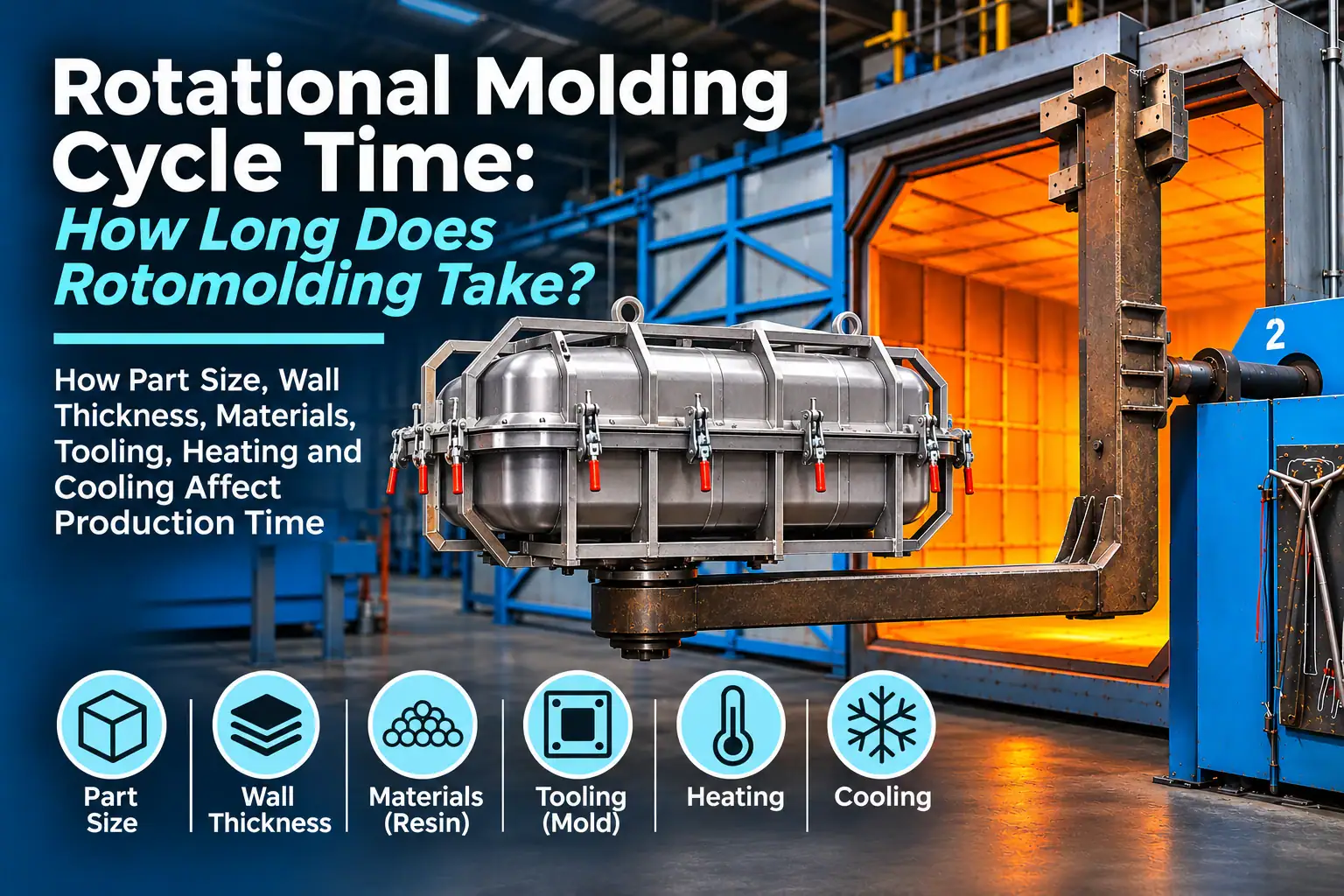
Rotational Molding Cycle Time: How Long Does Rotomolding Take?
How Part Size, Wall Thickness, Materials, Tooling, Heating and Cooling Affect Production Time
By RotationalMolding.com Editorial Team
Published November 4, 2026
Rotational molding cycle time is one of the most important factors affecting production capacity, manufacturing cost and the overall efficiency of a rotomolding program.
It is also one of the most difficult aspects of the process to reduce to a single number.
There is no universal answer to the question, “How long does rotational molding take?” A relatively small, thin-wall polyethylene component may require a very different production cycle than a large industrial tank, heavy-wall container or complex product containing inserts and difficult geometry.
The complete rotational molding cycle includes more than the time a mold spends inside an oven. Material must be loaded, heated, fused into a continuous wall, cooled sufficiently for removal, demolded and prepared for the next cycle.
Part size, wall thickness, material, mold construction, oven conditions, heat transfer, cooling method and product geometry can all influence total rotational molding cycle time.
At The Granger Plastics Company, cycle development is treated as part of the overall manufacturing process rather than as an isolated machine setting. The objective is not simply to run the shortest possible cycle. The objective is to produce a properly fused, dimensionally stable part repeatedly and efficiently.
Rotational Molding Cycle Time at a Glance
A rotational molding production cycle generally includes several distinct stages:
- Material loading — a measured amount of resin is placed into the mold.
- Mold closing and preparation — mold sections, vents, inserts and hardware are prepared for processing.
- Heating and rotation — the mold rotates biaxially while heat is transferred through the tooling to the resin.
- Melting, laydown and fusion — powdered resin melts, adheres to the mold surface and consolidates into the molded wall.
- Cooling — rotation continues while heat is removed from the mold and polymer.
- Demolding — the mold is opened and the finished part is removed.
- Servicing and reloading — the mold is prepared for the next production cycle.
The amount of time required for each stage varies dramatically from one product and mold to another.
How Long Does Rotational Molding Take?
Rotational molding should not be assigned a single standard cycle time across all products.
The process is fundamentally based on heat transfer. Heat must travel from the oven atmosphere through the mold wall and ultimately into the polymer. After the material has properly fused, that same thermal energy must be removed during cooling before the part can be safely demolded.
A small mold containing a relatively light resin charge can respond to heating and cooling much differently than a large mold containing hundreds of pounds of material.
Likewise, a product designed around a modest nominal wall may process substantially differently from a heavy-wall application.
This is why production estimates should be developed for the actual product, tooling and material rather than assuming that every rotationally molded component has the same cycle.
Heating Is Only Part of the Cycle
The heating portion of rotational molding begins after the charged mold enters the oven or heating environment.
As the mold rotates, its temperature increases. The resin initially remains in powder form, then begins adhering to the heated mold surface. With continued heating and rotation, additional material deposits onto the mold and gradually forms the wall of the product.
Eventually, the polymer particles melt and fuse together into a continuous layer.
The heating cycle must therefore accomplish considerably more than simply making the mold hot.
It must provide sufficient heat and time for:
- The tooling to reach the appropriate processing temperature
- Powder to begin adhering to the mold surface
- Resin to distribute through the geometry
- Polymer particles to melt and consolidate
- Trapped air between particles to escape or diffuse sufficiently
- The molded wall to achieve adequate fusion
Removing a mold from heat too early may produce under-cooked material, poor fusion, porosity or reduced mechanical properties.
Leaving a mold exposed to excessive heat may degrade the polymer or create other processing problems.
For a closer look at problems associated with inadequate or excessive processing, see our guide to common rotational molding defects.
Cooling Can Consume a Significant Portion of Cycle Time
Once sufficient fusion has been achieved, the mold moves into the cooling portion of the cycle.
Rotation normally continues as heat is removed from the tooling and polymer.
Cooling is not merely a delay before the operator can open the mold. It is an active part of forming the finished product.
As the resin cools, it changes from a molten state into a solid molded structure. Shrinkage occurs during this transition, and different sections of a product may cool at different rates.
Cooling conditions can therefore influence:
- Overall dimensional stability
- Shrinkage
- Warpage
- Flatness
- Part stiffness at demolding
- Surface appearance
- Residual internal stresses
Attempting to shorten the cooling stage without understanding these effects can create dimensional or quality problems that cost far more than the time saved.
For products containing important dimensional requirements, see our guide to rotational molding tolerances for a more detailed discussion of shrinkage, cooling and dimensional control.
Wall Thickness Has a Major Effect on Rotational Molding Cycle Time
Wall thickness is one of the most important factors affecting production time.
A heavier resin charge requires more thermal energy to heat through the molding cycle and generally requires more heat to be removed during cooling.
For that reason, increasing nominal wall thickness can affect more than material cost.
It may also increase:
- Heating requirements
- Oven residence time
- Cooling requirements
- Total machine occupancy
- Energy consumption
- Finished-part cost
This is one reason an unnecessarily thick part is not automatically a better part.
The proper wall should be based on structural requirements, impact performance, product geometry, service environment and expected life rather than simply adding additional resin.
For detailed guidance, see our article on rotational molding wall thickness.
Part Size Also Influences Cycle Time
Rotational molding is particularly valuable for producing large hollow products, but part size can significantly affect thermal behavior.
Large molds contain more tooling mass and generally present more surface area that must be heated and cooled.
A large product may also contain a substantially greater resin charge than a small component.
These factors can influence both the amount of energy required and the time needed to move the tooling and polymer through the desired temperature range.
Large products also frequently require more time for servicing, opening the mold, removing the finished part and reloading the tool.
Cycle time therefore needs to consider the complete manufacturing sequence rather than simply recording oven minutes.
Mold Construction Affects Heat Transfer
The mold is the thermal pathway between the processing environment and the resin.
Its construction therefore has a direct effect on how rapidly heat can enter and leave the cavity.
Important variables include:
- Mold material
- Mold-wall thickness
- Local reinforcement
- Flanges
- Frames and support structures
- Inserts and bosses
- Complex or shielded geometry
- Surface area exposed to heating and cooling
Aluminum and fabricated metal molds can behave differently because of differences in thermal conductivity, thickness and construction.
Even within the same mold, heavy structural areas may respond differently from thinner sections of tooling.
This means mold design affects not only the shape of the product, but also the way that product processes.
Learn more about the relationship between tooling and production in our guide to rotational molding molds.
Material Selection Can Change the Processing Window
Different rotational molding materials do not necessarily respond to heat in the same way.
Material characteristics such as density, melt index, particle size, thermal behavior and recommended processing conditions can affect how resin melts, flows, fuses and cools.
Polyethylene remains the most commonly processed material family in rotational molding, including LLDPE, MDPE and HDPE formulations.
Other materials may require significantly different processing strategies.
Changing a resin should therefore never be viewed only as changing the physical properties listed on a technical data sheet.
A material change can also affect how the mold needs to be processed.
For a deeper comparison of common polyethylene materials and their processing characteristics, see our guide to rotational molding polyethylene and resin selection.
Geometry Can Make a Part Faster or More Difficult to Process
Two products with approximately the same weight and outside dimensions may still require different cycle development because their geometry is different.
Complex features can change the way powder moves through the mold and the way heat reaches different surfaces.
Examples include:
- Deep recesses
- Narrow passages
- Closely spaced parallel walls
- Heavy bosses
- Molded-in inserts
- Sharp internal corners
- Double-wall geometry
- Large flat surfaces
A thermally shielded region may require more time to reach effective molding conditions even when other areas of the tool are already hot.
Likewise, difficult powder flow can create thin or incompletely filled areas even when the overall cycle appears adequate.
Proper rotational molding design can reduce these problems before tooling is constructed.
More Oven Temperature Does Not Automatically Mean a Better or Faster Cycle
It can be tempting to assume that simply increasing oven temperature will always shorten rotational molding cycle time.
Real processing is more complicated.
Oven temperature, mold temperature and the actual temperature experienced by the polymer are not the same measurement.
The mold has thermal mass. The resin also requires time to absorb heat, melt, fuse and release trapped air.
Driving heat into the mold more aggressively may accelerate portions of the cycle, but excessive thermal exposure can also create processing problems or increase the amount of energy that later needs to be removed during cooling.
Experienced rotomolding process development therefore focuses on the temperature history of the mold and material rather than relying solely on an oven setpoint.
Internal Air Temperature Can Help Control the Process
One method used in advanced rotational molding process control is monitoring the temperature of the air inside the mold.
The internal temperature profile can provide insight into major events taking place during the cycle, including powder adhesion, melting, consolidation and cooling.
This type of process information can be more useful than relying exclusively on elapsed oven time because it provides evidence of what is actually occurring inside the tool.
For repeat production programs, developing a stable thermal profile can help improve consistency from cycle to cycle.
Machine Configuration Can Affect Production Efficiency
Rotational molding equipment is available in several configurations, and machine layout can influence overall manufacturing efficiency.
Some systems allow multiple molds or arms to occupy different portions of the manufacturing sequence simultaneously. While one mold is heating, another may be cooling or being serviced.
This means that the cycle time of an individual mold is not always identical to the rate at which finished products can leave a complete manufacturing system.
Tooling quantity, machine-arm capacity, mold size, available stations and production scheduling all influence practical throughput.
This distinction becomes especially important when forecasting annual production volume.
Cycle Time and Production Volume Are Related — But Not the Same Thing
A shorter cycle generally increases potential machine capacity, but cycle time alone does not determine how many finished parts can be produced in a day, month or year.
Production volume also depends on:
- Number of molds available
- Number of cavities per mold
- Machine configuration
- Changeover requirements
- Insert installation
- Demolding complexity
- Secondary operations
- Quality inspections
- Labor requirements
- Production scheduling
A product with a longer individual mold cycle may still achieve substantial production volume if multiple molds are operated efficiently.
Conversely, a relatively fast molding cycle may not translate directly into high throughput if the product requires extensive manual servicing or post-molding operations.
Secondary Operations Are Not Part of the Oven Cycle — But They Affect Manufacturing Time
The molding machine is only one part of many rotational molding programs.
After removal from the tool, products may require additional operations such as:
- Trimming
- Drilling
- Machining
- Spin welding
- Hardware installation
- Assembly
- Leak testing
- Dimensional inspection
- Labeling
- Packaging
These operations may occur independently of the molding machine, but they still affect total manufacturing lead time and production capacity.
For quoting purposes, it is therefore important to separate molding cycle time from total labor and manufacturing time per finished product.
Why the Shortest Possible Cycle Is Not Always the Best Cycle
Reducing cycle time is valuable when it can be accomplished without compromising the finished product.
But the shortest cycle that physically produces something resembling a part is not necessarily the correct production cycle.
An overly aggressive attempt to save machine minutes can create:
- Incomplete fusion
- Excessive porosity
- Weak areas
- Distortion
- Poor dimensional repeatability
- Difficult demolding
- Increased scrap
- Inconsistent physical properties
If reducing a few minutes from a cycle causes increased scrap, rework or customer failures, it is not an efficiency improvement.
The correct cycle is the shortest repeatable process that consistently produces a part meeting the required material, structural, dimensional and cosmetic requirements.
How Rotational Molding Cycle Time Can Be Improved
Cycle-time improvement should focus on eliminating unnecessary thermal and operational inefficiency while maintaining product quality.
Depending on the application, opportunities may include:
- Improved mold design
- Appropriate mold material and wall construction
- Improved heat transfer to difficult regions
- Better part geometry
- Optimized resin charge
- Appropriate material selection
- Improved oven conditions
- More effective cooling
- Better rotation parameters
- Improved demolding procedures
- Efficient mold servicing and reloading
- Multiple molds when production volume justifies them
The best improvement depends upon where the actual bottleneck exists.
If the limiting factor is cooling, increasing oven performance will not solve the problem. If difficult geometry is preventing proper material laydown, adding more resin may increase both cost and cycle time without correcting the underlying issue.
Effective cycle development therefore requires evaluating the entire mold, material, machine and product system.
Cycle Time Should Be Considered During Product Development
Manufacturing economics are influenced by decisions made long before a mold reaches the production floor.
Wall thickness, product size, geometry, material, tooling construction and secondary operations can all influence eventual cycle time.
A product that is difficult to heat, cool, demold or service may remain expensive to manufacture throughout the life of the program.
Early collaboration between the product designer, tooling team and rotational molder can help identify these issues before they are permanently built into the mold.
This is one reason experienced rotomolding manufacturers evaluate both whether a product can be molded and how efficiently it can be molded repeatedly.
Frequently Asked Questions About Rotational Molding Cycle Time
How long does rotational molding take?
There is no single standard rotational molding cycle time. The required time depends on part size, wall thickness, resin, mold construction, geometry, heating conditions, cooling method and machine configuration.
What takes the most time during rotational molding?
Heating and cooling typically account for major portions of the mold cycle, but the balance between them varies by product and tooling. Large or heavy-wall parts can require substantial time both to absorb heat and later to release it.
Does thicker wall thickness increase rotational molding cycle time?
Generally, yes. Additional resin requires more heat to melt and consolidate and usually requires additional cooling. The effect depends on the part, mold and process.
Can higher oven temperature shorten the cycle?
Higher oven temperature may accelerate heat transfer during portions of the process, but it does not automatically produce a better or shorter overall cycle. Polymer temperature, mold thermal behavior, fusion and subsequent cooling must all be considered.
Does a larger rotationally molded part take longer?
Large products often require longer or more complex cycles because of mold mass, resin charge, surface area, cooling requirements and handling demands. Size alone, however, does not determine cycle time.
Why does cooling matter so much?
The polymer must cool sufficiently to solidify and become stable enough for removal from the mold. Cooling also affects shrinkage, warpage, flatness and dimensional control.
Can cycle time be reduced after production begins?
Often, yes. Process development may identify opportunities to improve heating, cooling, mold positioning, rotation, servicing or other variables. Any changes should be validated against finished-part quality rather than judged only by time saved.
Does faster cycle time always mean lower part cost?
Not necessarily. A faster cycle can improve machine productivity, but if it increases scrap, labor, quality problems or secondary operations, total manufacturing cost may increase rather than decrease.
Develop the Right Cycle — Not Simply the Shortest Cycle
Rotational molding cycle time is the result of a complete thermal and manufacturing system.
Part geometry, mold construction, resin, wall thickness, heating, rotation and cooling all interact to determine how quickly a product can be manufactured successfully.
For that reason, production cycle development should focus on repeatability and finished-part performance rather than simply minimizing elapsed minutes.
The Granger Plastics Company has more than three decades of experience developing rotationally molded products across industrial, aerospace, marine, material-handling and custom OEM applications. That experience allows our team to evaluate tooling, materials, processing and product design as an integrated manufacturing system.
If you are developing a new rotationally molded product, transferring existing tooling or evaluating the manufacturability of an existing design, request a rotational molding quote to discuss your application with The Granger Plastics Company.
For a broader explanation of the manufacturing method itself, visit our complete guide to the rotational molding process, design, materials and applications.