

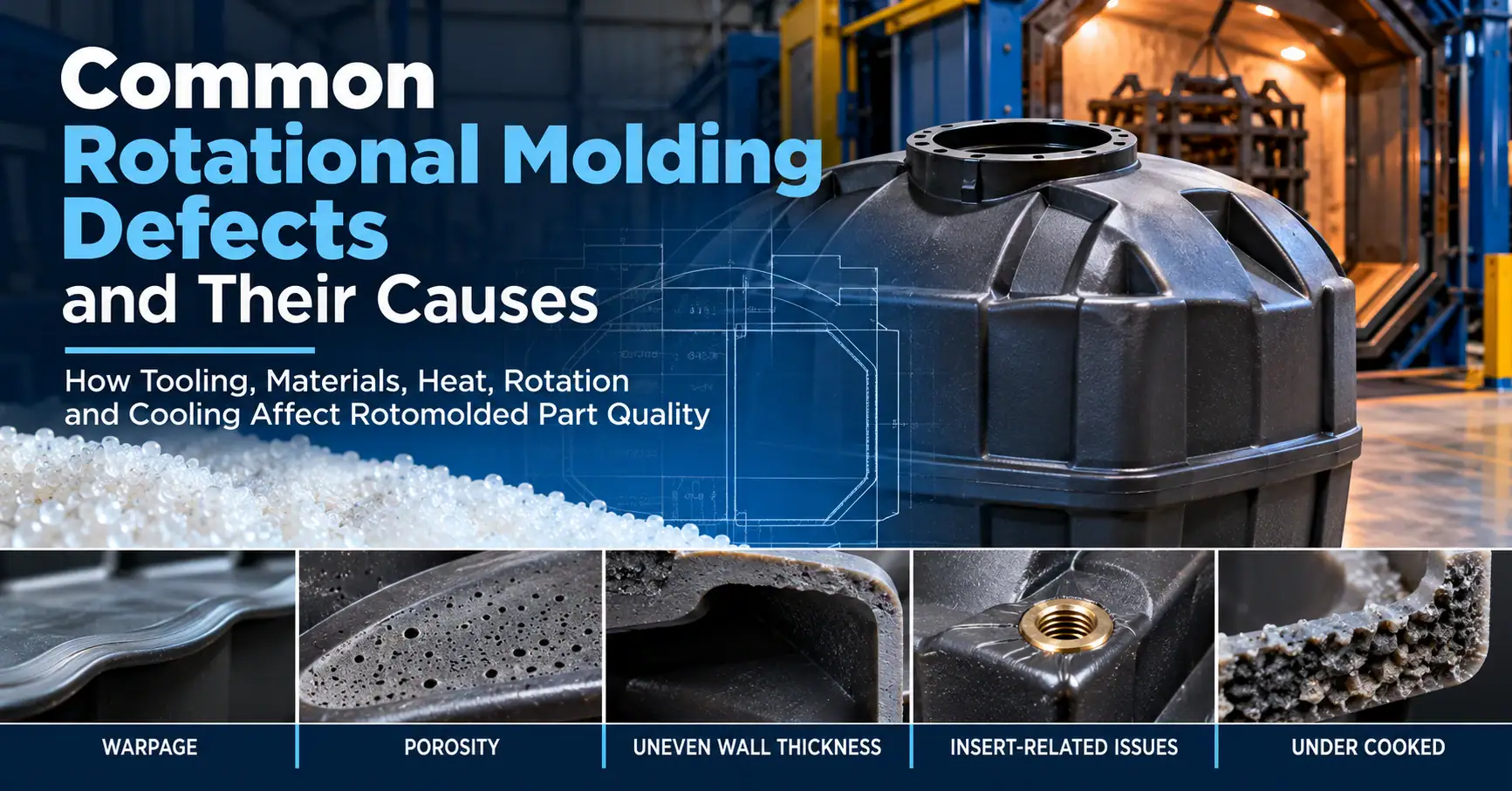
Common Rotational Molding Defects and Their Causes
How Tooling, Materials, Heat, Rotation and Cooling Affect Rotomolded Part Quality
By RotationalMolding.com Editorial Team
Published October 28, 2026
Rotational molding defects can occur when material selection, mold design, heating, cooling, rotational speed, venting or part geometry are not properly controlled. Rotational molding is capable of producing large, durable and highly complex hollow plastic products, but producing a quality rotomolded part requires much more than placing polyethylene powder into a mold and applying heat.
Material selection, mold design, heating, cooling, rotational speed, venting and part geometry all interact during the rotational molding process. When one or more of these variables are not properly controlled, the result may be warpage, porosity, uneven wall thickness, incomplete fusion or other molding defects.
Understanding why these problems occur is an important part of developing a successful rotationally molded product.
At The Granger Plastics Company, decades of rotational molding experience have demonstrated that many apparent “material problems” are actually process, tooling or design problems — and frequently involve several variables working together.
1. Warpage in Rotationally Molded Parts
Warpage is one of the most recognizable rotational molding defects.
A part may look correct when it exits the mold but distort as it cools, or large flat surfaces may bow inward or outward instead of maintaining their intended geometry.
Several conditions can contribute to warpage, including:
- Uneven cooling
- Improper venting
- Large unsupported flat surfaces
- Uneven wall thickness
- Excessive or insufficient heating
- Part geometry
- Mold shielding
- Resin characteristics
- Mold-release conditions
Cooling is particularly important because polyethylene shrinks as it cools.
If one area of a rotationally molded part cools significantly faster than another, the resulting differences in shrinkage can create internal stresses and dimensional distortion.
Large flat panels can be especially challenging. Whenever possible, designers may incorporate ribs, contours, radii or other geometric features that improve stiffness and dimensional stability.
The solution to warpage therefore isn't necessarily simply “cool the part more.”
Successful troubleshooting requires determining why different areas of the part are responding differently during the molding and cooling cycle.
2. Uneven Wall Thickness
One of the advantages of rotational molding is the ability to produce hollow parts without the high molding pressures associated with processes such as injection molding.
However, achieving consistent wall thickness across a complex rotationally molded product requires careful control of the molding process.
Potential causes of uneven wall thickness include:
- Mold geometry
- Incorrect rotational ratios or speeds
- Areas of the mold being shielded from heat
- Variations in mold-wall thickness
- Poor powder flow
- Deep recesses or narrow passages
- Localized hot or cold areas
- Part design
- Resin particle characteristics
During rotational molding, powdered resin gradually adheres to the heated interior surface of the mold as it rotates biaxially.
The polymer does not simply distribute itself evenly because the machine is rotating.
Complex geometry changes how powder moves through the mold and how heat reaches different areas of the tooling.
Corners, deep cavities, narrow passages and large projections can influence resin flow and heat transfer. Even the physical construction of the mold can affect where resin accumulates.
This is why rotational mold design and fabrication and process development must be considered together.
3. Porosity and Air Bubbles
Small bubbles or voids within the wall of a rotationally molded part are commonly associated with insufficient fusion or an incomplete molding cycle.
As polyethylene powder begins heating inside a rotational mold, particles soften, adhere to the mold surface and eventually fuse together.
Air initially exists between those powder particles.
As the material continues heating, the polymer must reach the proper processing condition for much of that trapped air to escape and the particles to fuse into a more continuous polymer structure.
If the material does not receive sufficient heat, excessive porosity may remain within the part wall.
Possible contributing factors include:
- Insufficient heating time
- Low mold temperature
- Poor heat transfer
- Resin particle characteristics
- Excessive wall thickness
- Mold geometry
- Improper cycle development
However, simply increasing oven temperature is not always the correct solution.
Too much heat can create an entirely different set of problems.
The objective is not to make the mold “as hot as possible.” It is to establish the correct combination of time, temperature and heat transfer for the specific mold, resin and part.
4. Under-Cured or Under-Fused Parts
An under-fused rotationally molded part has not received sufficient heat for the polymer to develop the intended level of fusion.
The outside of the part may appear relatively normal even though the internal structure has not developed properly.
Potential symptoms can include:
- Reduced impact strength
- Excessive internal porosity
- Weak corners or features
- Poor surface reproduction
- Incomplete resin coverage
One reason this condition can be difficult to diagnose visually is that rotational molding occurs from the mold surface inward.
A finished-looking exterior does not necessarily indicate that the entire wall has experienced the correct thermal cycle.
Experienced rotomolders therefore consider more than oven temperature alone.
Mold construction, part geometry, resin grade, wall thickness and actual heat transfer all influence how the polymer processes.
5. Overheated or Over-Cured Material
If insufficient heat can damage part performance, excessive heat can do the same.
Polyethylene exposed to excessively high temperatures or unnecessarily long heating cycles can experience oxidation and degradation.
Possible signs can include:
- Discoloration
- Reduced impact performance
- Surface deterioration
- Brittleness
- Unusual odor
- Degraded material in thin sections
A rotational molding cycle therefore needs a suitable processing window rather than simply maximizing oven time.
This becomes particularly important with large or complex molds where one portion of the mold may heat differently than another.
A cycle that is appropriate for one region of the part may expose another region to unnecessary thermal history.
Tooling design and process development again work together.
6. Resin Bridging and Incomplete Coverage
Complex rotationally molded products may contain narrow passages, deep recesses, ribs, handles or other geometric features that powdered resin must reach during rotation.
In some circumstances the powder may bridge across a narrow opening instead of flowing into the intended region.
This can result in:
- Thin sections
- Incomplete features
- Missing material
- Weak areas
- Uneven wall distribution
Possible causes can include poor powder flow, unsuitable geometry, rotational speed or ratio, localized mold temperatures and insufficient space for powder movement.
Designing features specifically for rotational molding can prevent many of these issues before tooling is constructed.
This is one reason applying injection-molding design rules directly to rotational molding can create problems. The processes distribute material in fundamentally different ways.
7. Parts Sticking in the Mold
Removing a finished rotationally molded part from its mold should be considered during both tooling design and production planning.
Parts can become difficult to remove because of:
- Insufficient draft
- Deep undercuts
- Rough or damaged mold surfaces
- Improper mold release
- Resin buildup
- Part shrinkage around mold features or inserts
- Poor parting-line design
Polyethylene shrinks during cooling, which means a part can tighten around certain mold features as its temperature decreases.
Proper draft angles, mold finish and thoughtful placement of parting lines can make demolding significantly easier.
Trying to solve a poor tooling geometry problem solely with additional mold-release agent may create other problems without addressing the actual cause.
8. Poor Impact Strength
A rotationally molded product can look perfectly acceptable and still fail to provide the expected mechanical performance.
Poor impact performance may result from:
- Improper resin selection
- Insufficient fusion
- Excessive heat exposure
- Poor pigment compatibility
- Stress concentrations
- Sharp corners
- Inappropriate wall thickness
- Part design
- Processing conditions
Material selection is particularly important.
Not all polyethylene grades offer identical toughness, stiffness, environmental stress-crack resistance or low-temperature performance.
Selecting resin based solely upon price or density can create problems when the finished product must withstand demanding service conditions.
At Granger Plastics, resin selection begins with understanding the actual application: temperature, structural requirements, chemical exposure, outdoor exposure, expected impact and intended service environment.
Learn more about rotational molding polyethylene and resin selection.
9. Problems Around Molded-In Inserts
One of rotational molding's valuable capabilities is incorporating metal inserts directly into a plastic part.
Threaded inserts, mounting points and other hardware can often be molded directly into the product.
However, inserts introduce another material into an otherwise polyethylene structure.
Metal and polyethylene respond differently to heating and cooling.
Poor insert design or placement can contribute to:
- Localized thinning
- Stress concentration
- Cracking
- Warpage
- Resin-flow problems
- Difficulty achieving proper encapsulation
Successful molded-in hardware requires considering insert geometry, placement, heat transfer and the way the plastic will shrink around the insert during cooling.
In some applications, secondary installation methods may be preferable.
10. Why Rotational Molding Defects Require Experienced Troubleshooting
One of the biggest mistakes in troubleshooting rotational molding is assuming that every defect has one cause.
A thin area could result from:
- Resin flow
- Mold geometry
- Rotational ratios
- Heat distribution
- Tooling construction
- Shielding
- Cycle conditions
Warpage could involve cooling, venting, geometry, material selection or several of those factors at the same time.
Changing one variable without understanding the entire process can sometimes solve one problem while creating another.
That is why experienced rotational molding process development considers the complete system:
Part Design → Mold Design → Material → Heating → Rotation → Cooling → Demolding
Each step affects the next.
Preventing Rotational Molding Defects Starts Before Production
Many rotational molding defects can be prevented before the first production part is ever molded.
Product designers, mold builders and rotational molders should work together early in the development process to evaluate:
- Part geometry
- Draft
- Radii
- Wall thickness
- Mold construction
- Resin selection
- Inserts
- Venting
- Parting-line placement
- Expected product performance
Changes that are relatively easy during the design phase can become considerably more expensive once a mold has been constructed.
For OEMs developing a new rotationally molded product, involving an experienced rotational molding manufacturer early in the design process can reduce tooling modifications, shorten development time and improve the likelihood of successful production.
For additional technical guidance, LyondellBasell publishes a detailed rotational molding troubleshooting guide covering common molding problems, probable causes and corrective actions.
Experience Matters in Custom Rotational Molding
Rotational molding may appear mechanically simple, but producing consistent, high-quality parts requires understanding how tooling, materials, heat, rotation and cooling interact.
The Granger Plastics Company has provided custom rotational molding, product development, tooling and manufacturing solutions since 1994.
From large industrial products and material-handling components to aerospace, tanks and specialized OEM applications, Granger works with customers to develop rotationally molded products designed for their actual operating requirements.
For additional information, explore our guide to the rotational molding process, learn more about rotational molding polyethylene and resin selection, or review considerations involved in rotational mold design and fabrication.
If you are developing a new rotationally molded product or experiencing challenges with an existing design, contact The Granger Plastics Company to discuss your application.