

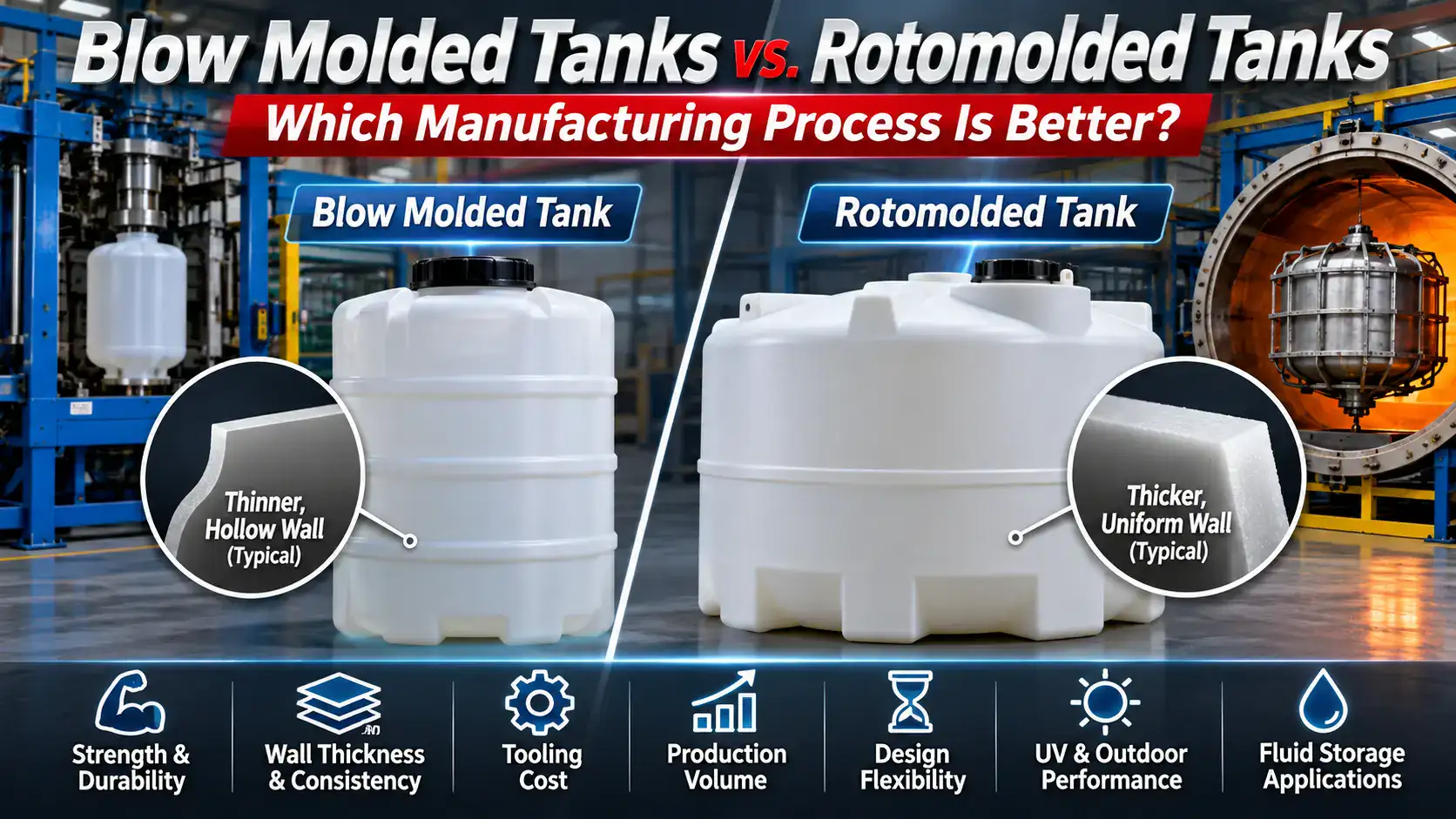
Blow Molded Tanks vs. Rotomolded Tanks: Which Manufacturing Process Is Better?
How manufacturing methods, wall thickness, tooling costs, production volume, and durability influence plastic tank design.
By RotationalMolding.com Editorial Team
Published November 6, 2026
Blow Molded Tanks vs. Rotomolded Tanks: Understanding the Difference
When developing a custom plastic tank, one of the most important decisions is choosing the manufacturing process. Two established methods for producing hollow plastic products are blow molding and rotational molding, also called rotomolding. Both can manufacture useful tanks, but they rely on different processing methods and often serve different production requirements.
The right choice depends on more than whether a tank can hold liquid. Capacity, geometry, wall thickness, fittings, expected annual demand, required properties, tooling investment and the operating environment all influence the decision. A tank intended for occasional industrial use can have very different requirements from a standardized reservoir produced by the tens of thousands.
For an overview beyond tank applications, read our rotational molding vs. blow molding process comparison. This guide focuses specifically on what those differences mean for plastic tanks.
How Are Blow Molded Plastic Tanks Manufactured?
In a common blow molding method known as extrusion blow molding, heated thermoplastic is extruded as a hollow tube, or parison. A mold closes around the parison, and compressed air expands the plastic against the mold cavity. The plastic cools, the mold opens, and the tank is removed for trimming or other finishing operations.
Other blow molding technologies and machine configurations exist, so the appropriate method depends on the resin, part design and manufacturing requirements. For a suitable tank geometry, the process can offer relatively short cycles and efficient repeat production.
Where Blow Molding Can Make Sense for Tanks
- Standardized tank or reservoir designs with high annual production quantities
- Products whose size and shape are compatible with available blow molding equipment
- Applications requiring relatively fast production cycles
- Projects where sufficient production volume can justify more demanding tooling and machine investments
A blow molded tank is not automatically weak or unsuitable for industrial use. Properly designed blow molded tanks can deliver excellent performance. Their suitability must be assessed against the actual service requirements, resin and wall-thickness distribution of the part.
How Are Rotomolded Plastic Tanks Manufactured?
During rotational molding, a measured quantity of polymer—frequently powdered polyethylene—is placed into a hollow mold. The mold is heated while rotating about two axes. The polymer melts and gradually coats the mold interior, forming a hollow plastic part. Controlled cooling follows while the mold continues rotating, after which the tank is removed.
Unlike blow molding, rotomolding does not rely on inflating a hot parison with compressed air. It is a relatively low-pressure manufacturing process, an important distinction when considering tooling construction, molded-in stresses and large hollow product geometry.
For large or customized tanks, rotomolding provides the ability to engineer the part around its intended function instead of limiting the design to a packaging-style shape. Learn more about our custom rotationally molded plastic tank capabilities.
Blow Molded Tanks vs. Rotomolded Tanks: Quick Comparison
| Consideration | Blow molded tanks | Rotomolded tanks |
|---|---|---|
| Basic process | Air pressure expands softened plastic into a mold | Heated rotating mold distributes and fuses polymer |
| Common production fit | Well suited to repeatable, higher-volume designs | Often attractive for custom, lower- to moderate-volume programs |
| Tooling | Can require substantial investment in pressure-capable tooling and equipment | Relatively low process pressure can allow more economical tooling for many designs |
| Wall thickness | Depends strongly on parison programming, stretch and tank geometry | Charge weight and tooling/process design can provide useful flexibility |
| Large custom shapes | Possible, subject to machine and parison limitations | A major strength of rotational molding, subject to machine capacity |
| Molded-in features | Part-specific feasibility; some features need secondary operations | Complex geometry, bosses and certain inserts may be incorporated through appropriate tooling |
| Cycle time | Often faster for suitable high-volume programs | Generally longer heating and cooling cycles |
| Best overall fit | Efficient standardized high-volume production | Large, durable, customized or specialized tanks |
This table describes common tendencies, not universal rules. Individual mold designs, materials and production systems can change the comparison.
Wall Thickness: A Major Tank Design Consideration
Wall thickness is particularly important for tanks because liquid weight, support conditions, impact, environmental exposure and handling loads can create demanding service requirements. The desired nominal thickness must be evaluated alongside actual thickness distribution, geometry and material properties.
Wall Thickness in Blow Molded Tanks
In extrusion blow molding, material distribution is influenced by the parison, the way it expands during inflation, the mold geometry and machine controls. As the plastic stretches to reach the mold surfaces, certain regions may become thinner than others. Modern equipment can compensate through parison programming and careful design, but controlling thickness distribution remains a central engineering consideration.
Wall Thickness in Rotomolded Tanks
In rotational molding, the amount of resin charged into the mold is an important control over nominal wall thickness. The finished tank is not guaranteed to have identical thickness everywhere: geometry, resin flow, heating, rotation and tooling details still matter. Outside corners often develop relatively favorable thickness distribution compared with stretched forming processes, although individual parts must be evaluated and tested.
For tanks with demanding structural requirements, rotational molding can also permit design changes that support local strength, including appropriate geometry, reinforcing features and wall-thickness strategies. The goal is not simply to make the entire tank as thick as possible, but to put appropriate material and structure where the application requires it.
What About Tank Durability and Impact Resistance?
A durable plastic tank begins with correct engineering. Material selection, design, process control, molded-part quality and real-world use conditions all affect service life. Rotomolding is frequently chosen for demanding industrial tanks because it can produce hollow, one-piece bodies with relatively low molded-in stress and substantial design flexibility.
However, neither manufacturing process automatically guarantees durability. A poorly designed rotomolded tank can fail, just as a well-engineered blow molded tank may provide long service. Testing should match the tank’s intended use, such as filled-load conditions, low-temperature impact, environmental stress cracking, fitting loads and chemical exposure.
Does Seamless Mean Leakproof?
Many rotationally molded tanks are produced as single-piece hollow bodies without joined body seams. Blow molding can likewise produce seamless hollow bodies. Neither fact guarantees leak resistance: vents, trimmed openings, fittings, threaded connections, gaskets, welds and service conditions must be considered independently. Finished tanks should be inspected and tested using a method appropriate to their application.
Tooling Cost: When Does Rotomolding Have an Advantage?
Because rotomolding operates at comparatively low forming pressures, the molds used to produce tanks can often be simpler and less costly than tooling for processes requiring more substantial forming forces. This can make custom tank development economically attractive when annual quantities do not justify a large tooling investment.
The tooling comparison is not fixed. Tank dimensions, details, inserts, mold sections, surface requirements, material, production quantities and tooling construction all affect cost. A relatively simple blow mold may be less expensive than an unusually complex rotational mold, and the production cost per part may tell a different story from the initial tool price.
Our article How Much Does a Mold for Rotational Molding Cost? explains why an accurate tooling quote requires a review of the actual finished-part design.
Production Volume: Why the Lowest Tooling Cost Is Not Always the Lowest Total Cost
Production volume can change the economics of a tank program. High-output blow molding equipment may spread a higher upfront investment across many units. Rotational molding commonly uses longer heating and cooling cycles, but can offer flexibility for different part sizes, specialized geometries and smaller production runs.
A manufacturer should compare the total program cost, not just a quoted unit price or mold price. Relevant factors include tooling, resin consumption, processing time, trimming, assembly, inspection, packaging, shipping, maintenance and expected demand over the life of the project.
For example, a customized tank with relatively modest annual demand may favor rotomolding, while a consistently ordered, standardized reservoir in very large quantities may justify investigating blow molding. Neither answer should be assumed without the dimensions, quantities and performance requirements.
Tank Size and Geometry Can Determine the Manufacturing Method
Rotational molding is well suited to many relatively large hollow parts, including industrial tanks and custom containment products. It can accommodate nonstandard shapes, integrated mounting features and complex geometries, subject to moldability and the available rotational envelope of the manufacturing equipment.
Blow molding also produces large hollow products, but a proposed tank must suit the selected blow molding process, including parison formation and stretching, mold configuration and machine capacity. As dimensions and geometry change, these constraints can become increasingly important.
It is especially valuable to involve a manufacturer before freezing the CAD design. A relatively small geometry adjustment may improve wall distribution, access, tooling complexity or production repeatability. Our rotational molding design resource explores these considerations in greater detail.
Polyethylene Selection for Plastic Tanks
Polyethylene is widely used for plastic tanks, but the specific resin grade matters. Linear low-density polyethylene (LLDPE), medium-density polyethylene (MDPE), high-density polyethylene (HDPE) and specialty materials provide different balances of stiffness, toughness, chemical resistance, processing behavior and stress-cracking performance.
For rotational molding applications at The Granger Plastics Company, appropriate prime virgin resin grades are the starting point for outdoor, structural and sensitive-use products. UV stabilization and UV-stable pigmentation are part of our standard material approach, but the final formulation and required performance should still be evaluated for each project.
A tank intended for chemical handling, potable water, food contact or elevated-temperature use requires material selection and any applicable compliance documentation specific to that intended service. No manufacturing method or polyethylene family should be treated as universally compatible with every stored substance.
For a detailed material discussion, see our LLDPE vs. HDPE resin selection guide.
Custom Fittings, Inserts and Secondary Operations
Tanks frequently require more than a hollow body. Fill and drain openings, threaded connections, mounting points, inspection access, handles, lids and identification features can all influence the selected manufacturing method.
Rotomolding can support a range of molded details and, where appropriate, molded-in inserts. Other features may require secondary machining, spin welding, fitting installation, sealing or assembly. The chosen construction method should reflect actual fitting loads and service requirements, not simply how easily a feature can be added during manufacturing.
Blow molded tanks may also incorporate engineered features and post-molding operations. The important question is which overall process best achieves the required finished assembly with repeatable quality and practical production cost.
Which Process Is Better for Agricultural, Industrial and Custom Tanks?
Agricultural and Water-Handling Tanks
Capacity, support, slosh loads, outdoor exposure, cleaning, drainage and installation method often drive the decision. Rotomolding may be attractive for customized shapes and rugged applications; blow molding may be appropriate for standardized high-demand products.
Industrial and Chemical-Handling Tanks
Chemical compatibility, operating temperature, stress cracking, secondary containment requirements, fittings and applicable standards are especially important. The process and resin must be evaluated together, with engineering validation for the intended service.
OEM Equipment and Specialty Reservoirs
An OEM tank may need to fit a compact envelope around other equipment, include multiple mounting locations or accommodate custom openings. Rotational molding often provides useful design freedom in these situations, particularly when production volume is not exceptionally high.
Large-Format Custom Tanks
Large hollow geometries are an established strength of the rotational molding process. Nevertheless, oven size, machine swing, arm capacity, tooling design, weight and handling limitations must be verified for each project.
Questions to Answer Before Choosing a Tank Manufacturing Process
- What liquid or other material will the tank contain, and at what temperature?
- What is the required capacity and available installation envelope?
- Will the tank be stationary, mobile, supported by a frame or exposed to impact?
- What nominal wall thickness and structural performance are required?
- Where are the openings, fittings, mounts and service-access points?
- What are the expected annual quantities and program life?
- What tooling investment and unit-cost targets are realistic?
- Are there testing, food-contact, potable-water or other regulatory requirements?
- Is the current CAD model designed for the chosen manufacturing process?
Getting these answers early helps avoid choosing a manufacturing process before the tank’s actual requirements are understood.
Frequently Asked Questions: Blow Molded vs. Rotomolded Tanks
Are rotomolded tanks stronger than blow molded tanks?
Not automatically. Performance depends on resin, actual wall-thickness distribution, part design, processing and service conditions. Rotational molding offers advantages for many rugged custom tanks, but strength must be evaluated on a design-by-design basis.
Are rotomolded tanks seamless?
Rotational molding can form a one-piece hollow tank body without welded body seams. Blow molding can also form one-piece hollow products. Any openings and fittings still require proper design and sealing.
Is blow molding cheaper than rotational molding?
It depends on the part and production quantity. Blow molding can offer attractive unit costs at high volumes; rotomolding can offer favorable tooling economics for custom or moderate-volume tank programs. Total lifetime program cost is the better comparison.
Can rotational molding make thick-wall plastic tanks?
Yes. Resin charge, material behavior, geometry, mold design and processing conditions are considered to produce the required wall thickness. Very thick walls may increase cycle time and require careful processing and cooling control.
Can blow molding manufacture large plastic tanks?
Yes, within the capabilities of the selected blow molding equipment and design. Large custom tank geometry can also be a strong application for rotational molding. Equipment limits should be reviewed before committing to tooling.
Which process is best for a custom tank with limited annual volume?
Rotational molding is often worth evaluating first because its tooling approach and design flexibility can suit customized, lower-volume manufacturing. The best method still depends on geometry, material, structural requirements and overall cost.
Choose the Manufacturing Process Around the Tank—not the Other Way Around
The decision between blow molded tanks and rotomolded tanks should begin with the tank’s function. Blow molding can be highly efficient for appropriate standardized, high-volume designs. Rotational molding is frequently compelling for large, durable and customized hollow tanks, where tooling flexibility and product engineering are central to the project.
The Granger Plastics Company has decades of experience manufacturing custom rotationally molded products, including plastic tanks for industrial and commercial applications. Our team evaluates material selection, product design, mold construction and production requirements together to help identify practical manufacturing solutions.
Explore our custom plastic tanks, learn more about rotational molding capabilities, or contact The Granger Plastics Company to discuss a new tank project.