

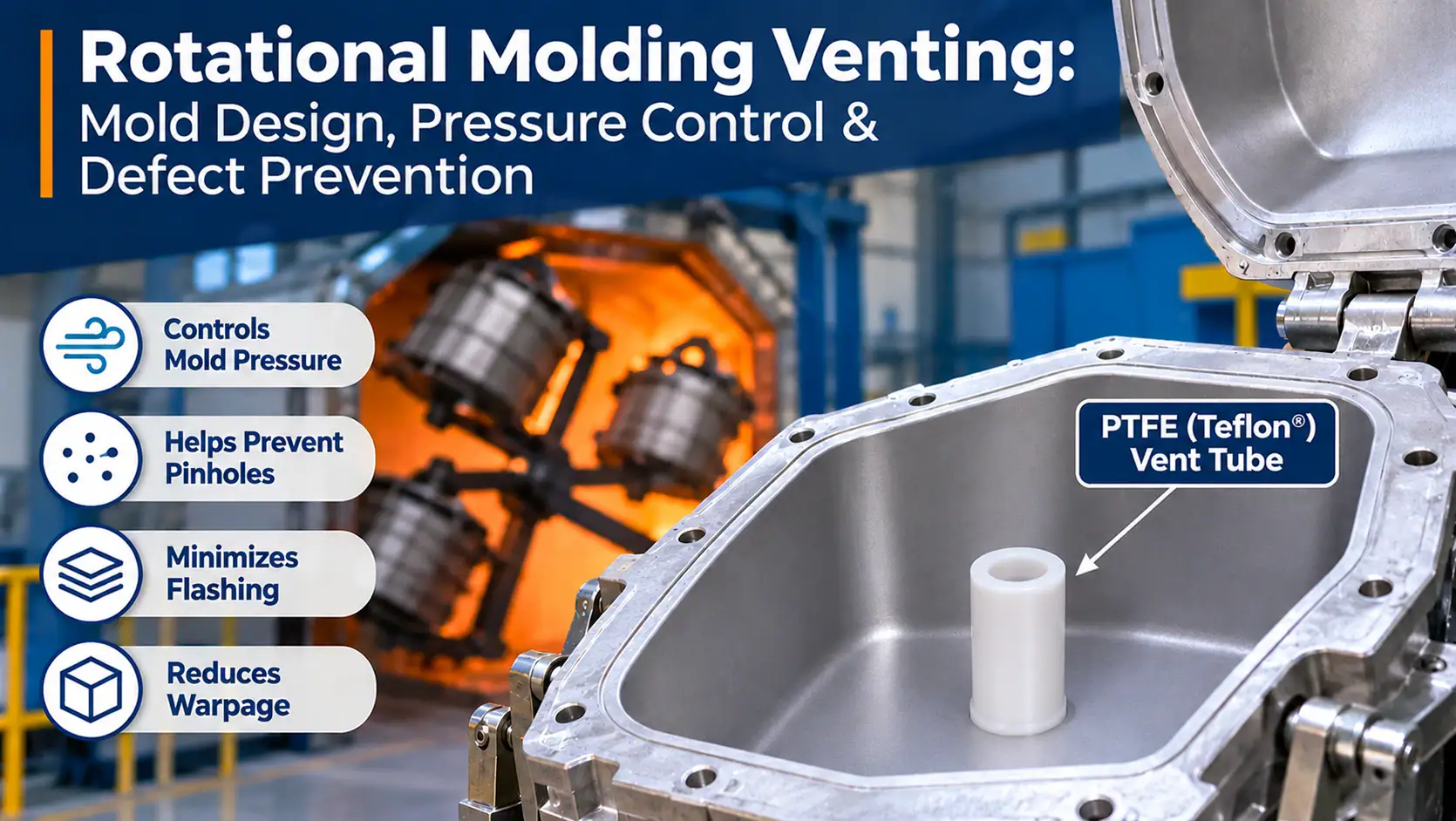
Rotational Molding Venting: Mold Design, Pressure Control & Defect Prevention
How Proper Mold Venting Helps Prevent Pinholes, Flashing, Warpage and Other Rotomolding Quality Problems
By RotationalMolding.com Editorial Team
Published November 17, 2026
Proper mold venting is an important but sometimes overlooked aspect of rotational molding. While rotomolding is commonly described as a low-pressure plastic manufacturing process, the air inside a rotating mold still expands during heating and contracts during cooling.
Without an effective venting system, these pressure changes can contribute to manufacturing defects, dimensional instability, unnecessary flashing, and difficulties maintaining consistent product quality.
At The Granger Plastics Company, mold design and processing considerations are evaluated together to support efficient manufacturing and consistent finished products.
Understanding how venting works can help engineers and OEMs develop better rotationally molded components and identify potential problems before production begins.
Why Do Rotational Molds Need Venting?
During rotational molding, a measured quantity of powdered thermoplastic resin is placed inside a hollow mold. The mold is heated while rotating around two axes, allowing the resin to melt and distribute across the interior mold surfaces.
As temperatures increase, the air inside the mold expands. If the mold cavity were completely sealed, internal pressure could rise during the heating cycle.
As the mold cools, the opposite occurs. Air temperature decreases, and the internal pressure can fall below atmospheric pressure.
A properly designed venting system allows air to move into and out of the mold cavity, helping equalize pressure throughout the manufacturing cycle.
Effective rotational mold venting can help:
- Reduce unwanted pressure buildup during heating.
- Minimize vacuum-related problems during cooling.
- Limit certain causes of pinholes and flashing.
- Improve dimensional consistency.
- Reduce the likelihood of pressure-related deformation.
- Support predictable processing and mold performance.
Venting is therefore an important part of overall rotational molding mold design, not merely an accessory added after tooling fabrication.
How Does Rotational Mold Venting Work?
A conventional rotational mold vent typically provides a controlled passage between the mold cavity and the surrounding atmosphere.
Depending on the tooling configuration, the system may incorporate a vent tube, protective packing material, or another suitable venting arrangement.
The vent must allow air to pass while minimizing unwanted resin escape, contamination, and blockage.
During heating, expanding air exits through the vent. During cooling, air can reenter the mold cavity as internal temperature and pressure decrease.
Although the basic principle is straightforward, effective venting depends on several factors:
- Mold cavity volume.
- Part geometry and configuration.
- Vent passage size.
- Vent location and orientation.
- Resin charge and processing conditions.
- Heating and cooling methods.
- Vent maintenance and cleanliness.
There is no single venting configuration that is appropriate for every rotationally molded product.
What Happens When a Rotational Mold Is Improperly Vented?
An undersized, obstructed, or poorly located vent can create quality problems that may appear elsewhere in the molded product.
1. Pinholes and Surface Imperfections
Poor pressure control can contribute to pinholes and other localized defects, particularly around mold parting lines.
When internal pressure is not relieved effectively, air may escape through unintended paths, potentially affecting the surrounding molten polymer.
However, pinholes can also result from other conditions, including inadequate fusion, moisture, contamination, and processing issues.
A comprehensive defect investigation should therefore examine the entire manufacturing process rather than assuming that every pinhole originates from improper venting.
For additional troubleshooting information, see our guide to common rotational molding defects.
2. Excessive Flashing at Mold Parting Lines
Flashing occurs when unwanted plastic material forms along mold joints or other tooling interfaces.
If pressure increases excessively inside a mold, molten resin may be forced toward openings around the parting line.
Venting problems can therefore contribute to excessive flashing.
Other possible causes include worn tooling, damaged mating surfaces, inadequate mold closure, and improper clamp pressure.
Our article on rotational molding parting lines discusses how mold construction and parting-line design influence finished product quality.
3. Warpage and Dimensional Distortion
During cooling, polymer shrinkage and changes in internal air pressure can influence the final shape of a rotationally molded component.
If the mold cannot admit sufficient air as the part cools, pressure differences may contribute to deformation or dimensional variation.
Venting alone cannot eliminate warpage. Material selection, cooling conditions, wall thickness, geometry, and molding parameters must also be considered.
For applications requiring accurate mating surfaces or controlled product dimensions, see our technical guide to rotational molding tolerances.
4. Vent Blockage and Resin Contamination
A vent that becomes obstructed by molten polymer, powder accumulation, or unsuitable packing material may no longer provide sufficient airflow.
Improper vent design can also create unwanted openings through which resin escapes or contamination enters the mold.
Vent condition and cleanliness should therefore be included in routine tooling inspection and maintenance procedures.
Important Rotational Mold Vent Design Considerations
Vent Size and Airflow Capacity
Vent passages must provide sufficient airflow for the mold cavity and operating conditions.
Larger molds generally require greater venting capacity than smaller molds, although cavity volume is not the only consideration.
A vent that works adequately on a small component may be unsuitable for a much larger industrial product.
Vent sizing should be evaluated using the mold cavity volume, vent arrangement, expected pressure changes, and relevant tooling design guidelines.
Vent Location
Vent placement should account for both product functionality and production requirements.
Important considerations include whether the vent location will:
- Interfere with an appearance-critical surface.
- Create an unwanted opening in the finished product.
- Affect a functional surface or mating feature.
- Become obstructed during processing.
- Permit unwanted moisture or contaminants to enter.
- Complicate trimming or secondary operations.
In some applications, the vent can be positioned within material that will subsequently be removed during finishing.
In other cases, the vent opening may be incorporated into an acceptable location in the finished component.
Vent Maintenance
Even a correctly designed vent may perform poorly if it is not maintained.
Tooling inspections should include checking for obstructed passages, damaged components, improper packing materials, and other conditions that interfere with pressure equalization.
Consistent maintenance becomes particularly important for molds operating through repeated production cycles.
How Venting Relates to Wall Thickness and Product Geometry
Rotational molding permits manufacturers to produce relatively large, hollow plastic components without the injection pressures associated with injection molding.
However, product geometry and wall construction still influence heating, cooling, shrinkage, and manufacturing consistency.
Large flat surfaces, deep recesses, restrictive features, and substantial differences in section geometry can introduce additional processing considerations.
A well-designed venting system works alongside other engineering decisions rather than replacing them.
For related information, review our guide to rotational molding wall thickness and our article on rotational molding ribs, gussets and structural reinforcement.
Venting Should Be Evaluated Before Mold Fabrication
One of the most effective ways to avoid vent-related problems is to consider venting during the initial design and tooling review.
Before a rotational mold is constructed, engineers should understand the intended product geometry, material selection, functional requirements, critical dimensions, and expected production conditions.
This approach helps determine suitable vent locations, service access, tooling configuration, and any necessary secondary operations.
Modifying a mold after production begins may be possible, but identifying important manufacturing requirements before tooling fabrication can reduce unnecessary changes and production interruptions.
Frequently Asked Questions About Rotational Molding Venting
Does every rotational mold require a vent?
Most conventional rotational molds require a means of pressure equalization during heating and cooling. The design and configuration depend on the tooling, material, process, and product requirements.
Can inadequate venting cause pinholes?
Yes. Inadequate venting can contribute to certain pinholes and surface defects, especially when pressure escapes through unintended openings. However, not all pinholes are vent-related.
Can proper mold venting prevent warpage?
Proper venting can reduce pressure-related contributions to deformation, but warpage is also affected by material shrinkage, product geometry, wall thickness, cooling, and other processing factors.
Where should a rotational mold vent be located?
Vent placement depends on mold geometry, accessibility, airflow requirements, surface appearance, and product functionality. It should be established during the tooling design process.
Does rotational molding use high internal pressure?
Conventional rotational molding is a low-pressure manufacturing process. Nevertheless, air inside the mold expands during heating and contracts during cooling, making controlled pressure equalization important.
Work With an Experienced Rotational Molding Manufacturer
Successful rotational molding requires more than selecting a resin and building a mold.
Product design, tooling construction, material selection, heating, cooling, venting, and secondary operations must work together to produce consistent finished components.
The Granger Plastics Company provides custom rotational molding manufacturing, engineering support, mold fabrication, mold modification, and related production services.
Whether developing a new product, evaluating existing tooling, or addressing manufacturing challenges, working with an experienced rotational molder can help identify practical solutions before unnecessary costs arise.
Explore our complete rotational molding capabilities or contact our team to discuss your application.