

Types of Rotational Molding Machines: Carousel, Shuttle, Rock-and-Roll & More
How Machine Configuration, Part Size, Production Volume and Processing Requirements Influence Rotomolding Equipment Selection
By RotationalMolding.com Editorial Team
Published November 5, 2026
Rotational molding can be used to manufacture an unusually wide range of hollow plastic products, from relatively small components to extremely large tanks, containers, material-handling products, marine components and custom industrial parts.
One reason for this versatility is the variety of rotational molding machines available to manufacturers.
Although the fundamental rotational molding process remains similar, the equipment used to perform that process can differ substantially. Machine configuration can influence mold capacity, part size, production efficiency, cycle scheduling, mold changes and the types of products that can be manufactured efficiently.
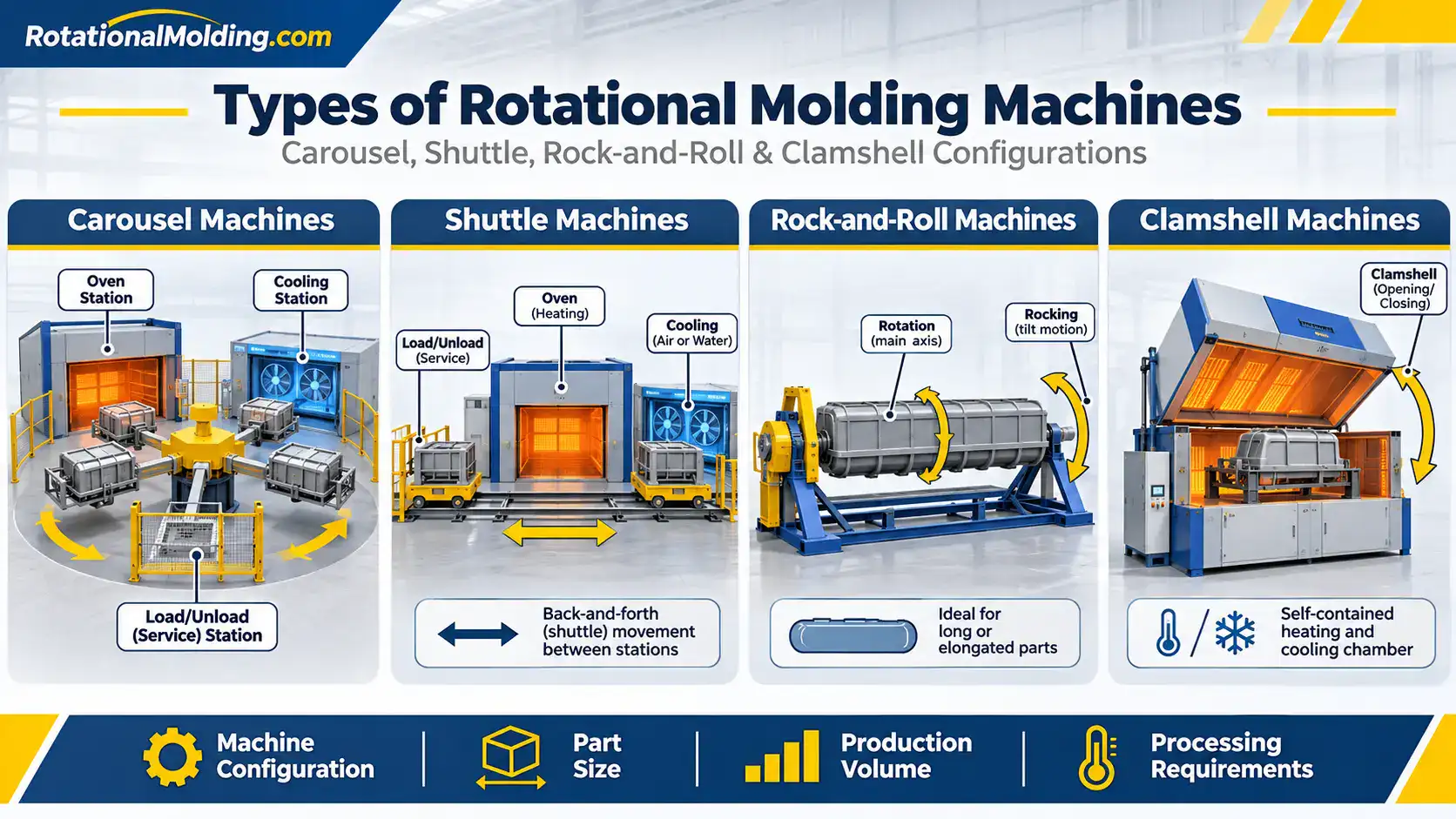
The primary types of rotational molding machines include:
- Carousel machines
- Shuttle machines
- Rock-and-roll machines
- Clamshell machines
- Specialized and custom rotational molding systems
Within those categories, additional differences such as straight arms, offset arms, independent arms, station layouts and machine swing capacity further affect manufacturing capability.
Understanding these differences helps explain why selecting a rotational molding manufacturer involves more than simply determining whether a company owns a rotomolding machine. The equipment must be appropriate for the size, geometry, production requirements and processing needs of the product being manufactured.
What Does a Rotational Molding Machine Do?
A rotational molding machine provides the controlled movement, heating and cooling necessary to manufacture a rotationally molded plastic part.
During the basic rotational molding process, a measured amount of powdered plastic resin is placed inside a hollow mold.
The closed mold is then heated while rotating around two axes. As the mold becomes hot, the resin gradually melts and coats the internal mold surfaces.
Once the material has properly fused, the mold enters the cooling portion of the process while rotation continues. After sufficient cooling, the mold can be opened and the finished part removed.
While this basic sequence applies across most conventional rotomolding equipment, different machine configurations handle the heating, cooling and mold-servicing stages in different ways.
Those differences can significantly affect production scheduling and manufacturing efficiency.
1. Carousel Rotational Molding Machines
The carousel rotational molding machine is one of the most widely recognized machine configurations used in commercial rotomolding.
A carousel machine generally uses multiple mold-carrying arms positioned around a central machine structure. These arms move molds between separate manufacturing stations.
Typical stations include:
- Mold loading and servicing
- Heating or oven
- Cooling
- Additional waiting, pre-cooling or service stations on some machines
The arrangement resembles a carousel because the mold-carrying arms move from station to station around a central point.
How a Carousel Rotomolding Machine Works
On a traditional three-arm carousel, one mold-carrying arm may be inside the oven while another is cooling and another is being unloaded, serviced and prepared for the next molding cycle.
This allows multiple stages of production to occur at the same time.
Instead of waiting for one mold to complete the entire molding sequence before another part begins production, the machine can keep several molds progressing through different stages.
This makes carousel equipment highly productive when the products being manufactured have compatible processing requirements.
Fixed-Arm vs. Independent-Arm Carousel Machines
Carousel machines may use arms that index together or arms capable of moving more independently.
On a fixed or turret-style system, the arms generally advance through the stations in a coordinated relationship.
This arrangement can be highly efficient when the products running on the different arms have relatively similar:
- Heating requirements
- Cooling requirements
- Mold servicing times
- Overall cycle requirements
Independent-arm carousel machines provide greater scheduling flexibility because individual arms may be able to progress through the machine according to their own processing requirements.
That flexibility can be valuable when manufacturing different products whose cook, cooling or service times vary.
However, machine utilization still requires careful scheduling. Rotational molding production is not simply a matter of moving a mold through an oven as quickly as possible.
The proper cycle must be established for the individual product, resin, wall thickness and mold.
For more information, see our guide to rotational molding cycle time.
2. Shuttle Rotational Molding Machines
A shuttle rotational molding machine uses a different layout.
Rather than moving mold arms around a central carousel, shuttle systems generally move molds back and forth between an oven and external cooling or servicing areas.
A common configuration uses a central oven with mold-carrying arms or carriages positioned on opposite sides.
While one arm is inside the oven, another mold may be cooling, being unloaded or prepared for another production cycle.
Advantages of Shuttle Machines
Shuttle machines can provide considerable flexibility and are frequently associated with larger molds and large rotationally molded products.
Potential advantages include:
- Ability to accommodate large mold envelopes
- Flexible mold scheduling
- Convenient mold access
- Ability to operate different tooling configurations
- Efficient production of larger custom parts
- Easier accommodation of products with differing cycle requirements
Machine size, however, is only one consideration.
The manufacturer must also consider mold weight, rotational envelope, arm capacity, oven dimensions, part geometry and the space required for the mold to rotate safely.
For very large rotationally molded components, machine capacity can become an important early consideration during product development.
3. Rock-and-Roll Rotational Molding Machines
Rock-and-roll rotational molding machines are specialized equipment commonly associated with long or elongated products.
Traditional biaxial rotational molding rotates a mold continuously around two perpendicular axes.
Rock-and-roll equipment uses a somewhat different motion. The mold typically rotates continuously around one axis while undergoing a rocking or oscillating motion around another.
This motion can be particularly useful for certain long, narrow geometries.
Applications may include products such as:
- Long tanks
- Kayaks and watercraft components
- Troughs
- Long industrial containers
- Specialty elongated hollow products
Rock-and-roll processing requires careful control of resin movement, heating and rotation.
As with any rotational molding application, the objective is not simply to move material inside the mold. The process must distribute, melt and fuse the resin in a manner that produces the required wall thickness and finished-part performance.
Product geometry therefore plays an important role in determining whether conventional biaxial rotation or a specialized machine configuration is more appropriate.
4. Clamshell Rotational Molding Machines
A clamshell rotational molding machine typically performs multiple processing stages within a common machine envelope.
Rather than moving several mold arms through separate oven and cooling stations, a clamshell system generally uses a single mold-carrying arm and a chamber capable of performing heating and cooling functions at different stages of the cycle.
After molding and cooling are complete, the arm is positioned for servicing and part removal.
Where Clamshell Machines Can Be Useful
Clamshell equipment can provide considerable process flexibility because one mold can proceed through its cycle without needing to coordinate its timing with multiple other mold arms.
They may be useful for:
- Specialized manufacturing
- Lower production volumes
- Development programs
- Products with unusual processing requirements
- Situations where manufacturing flexibility is more important than maximum throughput
The tradeoff is productivity.
Because heating, cooling and servicing generally occur sequentially for a single arm, a clamshell machine does not provide the same simultaneous multi-station production capability as a multi-arm carousel.
This illustrates an important principle in rotomolding:
The most appropriate machine is not necessarily the machine capable of producing the greatest number of parts per hour.
The appropriate equipment depends on the product.
Straight Arms and Offset Arms in Rotational Molding
Another important distinction involves the type of arm used to carry rotational molding tooling.
Two terms frequently encountered are:
- Straight arm
- Offset arm
These should not be confused with the primary machine categories such as carousel or shuttle.
They describe how molds are positioned and rotated on the machine.
Straight Arms
A straight-arm configuration places the mold-supporting structure generally in line with the primary rotational axis.
Multiple molds may sometimes be mounted to a supporting structure or spider depending on mold size and machine capacity.
Straight-arm systems can be efficient when the tooling fits appropriately within the available rotational envelope.
Offset Arms
An offset arm positions the mold away from the centerline of the primary arm.
Depending on machine design, this configuration can provide useful clearance and allow larger or differently shaped molds to utilize the available rotational space.
Machine manufacturers may offer several offset-arm configurations to accommodate different mold sizes, weights and geometries.
The correct arm configuration is therefore another part of determining whether a particular mold fits a machine.
Machine Swing Diameter and Rotational Envelope
One of the most important machine-capacity considerations in rotational molding is the rotational envelope, sometimes described in terms of machine swing diameter.
A mold must have enough clearance to rotate through its complete range of motion without contacting the machine structure, oven or other equipment.
This becomes particularly important with:
- Large molds
- Deep molds
- Offset tooling
- Irregular mold shapes
- Multiple molds mounted to a common spider
The dimensions of the finished plastic part alone do not determine whether the mold will fit the machine.
The tooling itself may be substantially larger than the final product because of mold flanges, framing, clamps, support structures and mounting hardware.
For this reason, mold design and machine selection should be considered together whenever particularly large products are being developed.
Learn more about rotational molding molds and tooling.
How Machine Type Affects Rotational Molding Cycle Time
Machine configuration can influence production efficiency, but it does not independently determine the proper molding cycle.
A rotational molding cycle may be influenced by:
- Part size
- Nominal wall thickness
- Resin type
- Mold material
- Tooling mass
- Product geometry
- Oven conditions
- Internal mold temperature
- Cooling method
- Required finished-part properties
A large carousel machine may allow several products to progress through different production stages simultaneously, but it cannot eliminate the heating and cooling requirements of the individual part.
Likewise, increasing oven temperature does not automatically produce a better or more efficient molding cycle.
The resin must experience the appropriate thermal history for proper melting and fusion without creating unnecessary material degradation or manufacturing defects.
This is why machine capacity and process control are both important.
Wall Thickness and Machine Selection
Rotational molding is capable of manufacturing products across a substantial range of wall thicknesses.
However, thicker rotationally molded parts generally require additional material to be heated completely through the molding cycle and may also require longer cooling periods.
This can influence:
- Oven requirements
- Cooling requirements
- Total cycle time
- Machine scheduling
- Mold handling
- Production capacity
Heavy-wall products should therefore be evaluated not only according to physical mold size but also according to their processing requirements.
Our rotational molding wall thickness guide explains how wall thickness interacts with part geometry, materials, heating, cooling and product performance.
Part Size and Rotomolding Machine Capacity
One of the advantages of rotational molding is its ability to manufacture relatively large hollow plastic parts.
Unlike many high-pressure plastics processes, rotational molding does not require extremely high injection or clamping pressures.
This can make the process particularly attractive for products such as:
- Large plastic tanks
- Industrial containers
- Material-handling products
- Marine components
- Large housings
- Custom OEM components
However, every rotational molding machine has physical limits.
Manufacturers must evaluate:
- Oven dimensions
- Machine swing
- Arm capacity
- Mold weight
- Tooling geometry
- Mold mounting arrangement
- Cooling clearance
For very large custom products, machine capability should be discussed early in the design process rather than after tooling has already been built.
Mold Construction and Machine Compatibility
Rotational molding molds can be manufactured using several construction methods and materials depending on the application.
Common tooling may include:
- Fabricated metal molds
- Cast aluminum molds
- Machined tooling
- Specialized prototype or development tooling
The mold must not only create the desired finished geometry. It must also function properly with the selected rotational molding machine.
Important considerations may include:
- Mold weight
- Mounting points
- Frame design
- Balance
- Parting lines
- Clamp placement
- Venting
- Rotational clearance
- Heat transfer characteristics
Poorly designed tooling can create processing difficulties regardless of the capability of the machine.
That is one reason experienced rotational molders evaluate tooling, product design and processing requirements as a complete manufacturing system rather than as independent decisions.
Machine Type Does Not Determine Part Quality by Itself
It would be incorrect to assume that one category of rotational molding machine automatically produces higher-quality products than another.
Finished-part quality depends on much more than machine style.
Important factors include:
- Product design
- Mold construction
- Material selection
- Resin quality
- Powder characteristics
- Material charge weight
- Rotation ratios
- Heating control
- Cooling control
- Mold venting
- Operator knowledge
- Process repeatability
A sophisticated machine cannot compensate for poor product design, inappropriate resin or an improperly developed molding cycle.
Likewise, the right equipment in the hands of an experienced rotational molder can produce highly consistent products across a wide variety of applications.
Choosing a Rotational Molding Company Based on Equipment Capability
When evaluating a rotational molding company, customers should consider whether the manufacturer has equipment appropriate for the proposed product.
Useful questions may include:
- Can the machine physically accommodate the mold?
- Is the machine arm capable of supporting the tooling weight?
- Can the mold rotate through the required envelope?
- Does the manufacturer regularly produce products of similar size?
- Can the equipment support the required wall thickness and heating requirements?
- Can different cycle requirements be accommodated?
- Does the manufacturer understand mold design and machine compatibility?
- Is the process controlled around product requirements rather than simply machine availability?
The best machine for a project is the machine that supports the proper manufacturing process for that particular product.
This is especially important for custom rotational molding programs where tooling may be expected to remain in production for many years.
Rotational Molding Equipment and Product Design Should Be Considered Together
Many manufacturing problems can be prevented when product design, tooling and machine requirements are considered together before a mold is constructed.
Important design considerations can include:
- Overall dimensions
- Wall thickness
- Draft
- Inside and outside radii
- Deep recesses
- Parallel walls
- Inserts
- Mold access
- Parting-line location
- Required tolerances
- Cooling behavior
- Mold removal
Our rotational molding design guide provides additional information about developing parts specifically for the rotomolding process.
This early collaboration is particularly useful when designing large, complex or unusual products where mold geometry may approach the limits of available equipment.
Which Type of Rotational Molding Machine Is Best?
There is no single best rotational molding machine for every product.
A carousel machine may provide excellent productivity for certain production programs.
A shuttle machine may provide greater flexibility for large molds.
A rock-and-roll system may be appropriate for specialized elongated products.
A clamshell machine may offer flexibility for specialized or lower-volume work.
The correct choice depends on the combination of:
- Product size
- Geometry
- Mold size
- Mold weight
- Material
- Wall thickness
- Required production quantity
- Heating requirements
- Cooling requirements
- Manufacturing schedule
The machine is therefore one component of a much larger manufacturing process.
Frequently Asked Questions About Rotational Molding Machines
What are the main types of rotational molding machines?
Common rotational molding machine configurations include carousel, shuttle, rock-and-roll and clamshell machines. Specialized systems may also be used for unusual products or manufacturing requirements.
What is a carousel rotational molding machine?
A carousel rotomolding machine uses multiple mold-carrying arms that move between separate heating, cooling and servicing stations. This allows several stages of the molding process to occur simultaneously.
What is a shuttle rotational molding machine?
A shuttle machine generally moves molds back and forth between an oven and cooling or servicing areas. Shuttle systems can provide considerable flexibility and are frequently used for larger molds and custom products.
What is a rock-and-roll rotomolding machine?
A rock-and-roll machine combines continuous rotation around one axis with a rocking or oscillating motion around another. This machine style can be particularly useful for long or elongated hollow products.
What is a clamshell rotomolding machine?
A clamshell machine typically performs heating and cooling within a common machine envelope using a single mold-carrying arm. It provides process flexibility but generally has lower production throughput than multi-station carousel equipment.
Is an offset arm a type of rotational molding machine?
Not exactly. An offset arm is a mold-carrying arm configuration that may be used on certain rotational molding machines. It changes how tooling is positioned within the available rotational envelope.
Can rotational molding manufacture very large parts?
Yes. Rotational molding is particularly well suited for many large hollow plastic products. Actual size capability depends on mold dimensions, machine swing, oven size, arm capacity and tooling geometry.
Does the type of machine affect rotational molding quality?
Machine capability matters, but machine type alone does not determine quality. Product design, tooling, resin selection, heating, cooling, rotation, process control and manufacturing experience all contribute to finished-part quality.
Choosing the Right Equipment for the Right Rotational Molding Application
Rotational molding equipment has evolved into numerous configurations because the products manufactured by the process vary enormously in size, shape, wall thickness and production requirements.
Carousel, shuttle, rock-and-roll and clamshell machines each provide different manufacturing advantages.
However, equipment selection should never be considered independently from the product itself.
The most effective rotational molding programs match product design, tooling, material, machine capability and processing conditions to the requirements of the finished part.
The Granger Plastics Company has decades of experience developing and manufacturing custom rotationally molded products across a broad range of sizes, geometries and applications.
If you are evaluating a new product or determining whether rotational molding is appropriate for an existing design, visit our rotational molding resource center or request a quote to discuss your application.