

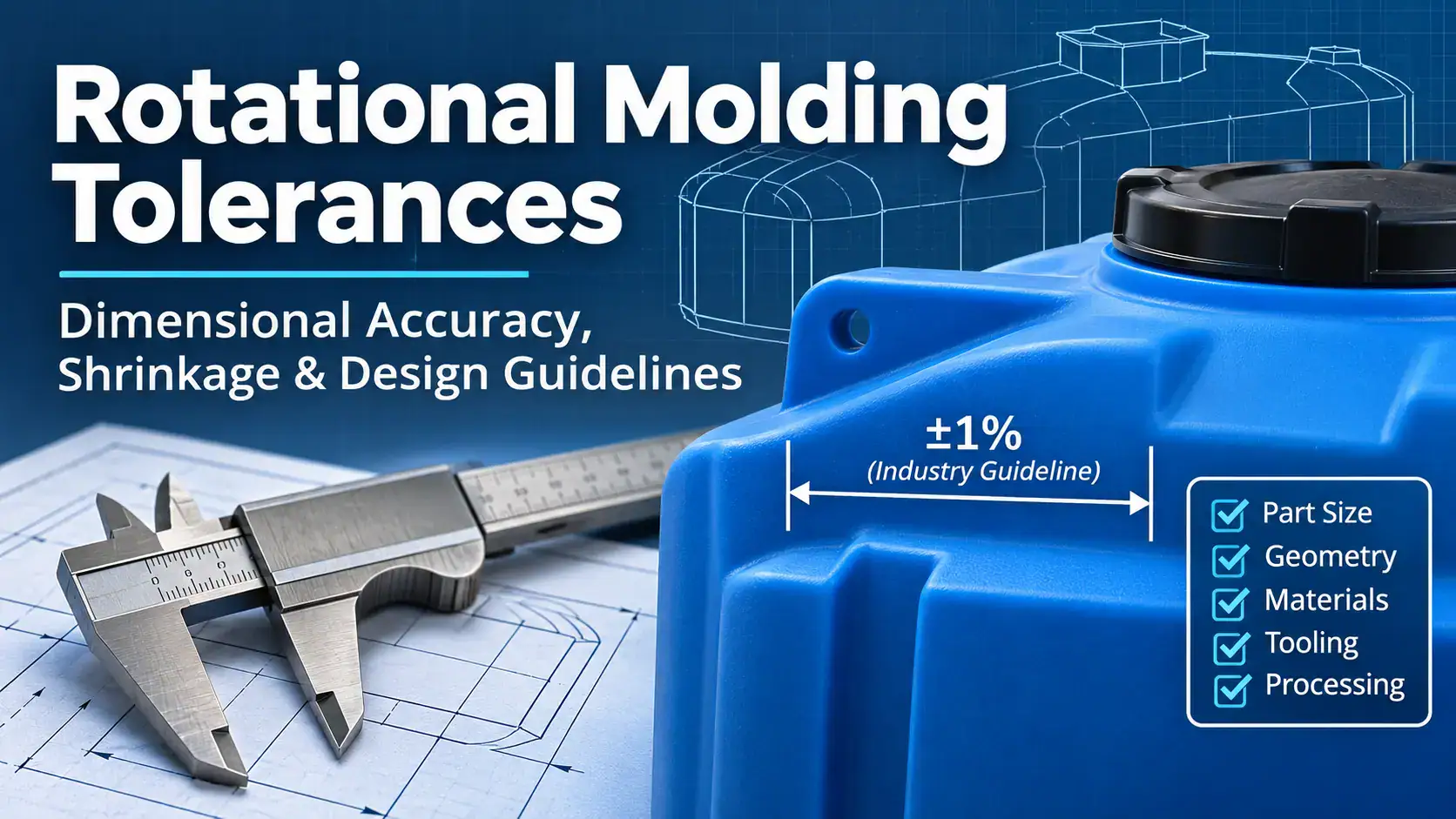
Rotational Molding Tolerances: Dimensional Accuracy, Shrinkage & Design Guidelines
How Part Size, Geometry, Material, Tooling and Processing Affect Dimensional Accuracy in Rotomolded Parts
By RotationalMolding.com Editorial Team
Published November 3, 2026
Understanding rotational molding tolerances is important when designing a plastic product that must fit with other components, maintain critical dimensions or perform consistently in an assembly.
Rotational molding can manufacture very large, durable and complex hollow plastic products, but dimensional expectations should reflect the characteristics of the process.
Unlike injection molding, rotational molding does not use high pressure to force molten plastic against every mold surface. Polymer—most commonly powdered polyethylene—is heated inside a hollow mold while the mold rotates around two axes. The material gradually melts and coats the interior surface before the part is cooled and removed.
That low-pressure process provides substantial advantages in tooling cost, part size and design flexibility, but it also means that shrinkage, cooling, part geometry and wall construction can influence the final dimensions of the molded product.
For that reason, successful rotomolded products are generally designed around the dimensions that truly matter rather than attempting to hold every dimension unnecessarily tight.
Rotational Molding Tolerances at a Glance
Several factors have a major influence on dimensional accuracy in rotational molding:
- Overall part size
- Material shrinkage
- Part geometry
- Nominal wall thickness
- Mold construction
- Heating and cooling conditions
- Location of the dimension relative to the mold surface
- Resin grade and formulation
- Color and pigment system
- Post-mold cooling and fixturing
The most important design principle is simple:
Not every dimension on a rotationally molded product should be treated as a precision dimension.
Critical mating surfaces, mounting points, inserts, openings and interfaces should be identified early in the design process. Other dimensions should generally be given enough tolerance to accommodate the normal behavior of the material and manufacturing process.
What Is a Typical Rotational Molding Tolerance?
As a general industry guideline, rotational molding tolerances are often discussed at approximately ±1% of the dimension, depending on part size, geometry, material, tooling and processing conditions.
That should not be interpreted as a fixed limit for every rotomolded product.
On many applications, The Granger Plastics Company can hold tighter tolerances through a combination of product design, tooling strategy, controlled processing, cooling methods, dimensional fixtures, molded-in features and secondary operations.
The practical tolerance for a particular feature depends on how that dimension is created and how critical it is to the function of the finished product.
For this reason, Granger prefers to identify critical dimensions during the design and tooling stage rather than applying one universal tolerance to an entire part.
Material Shrinkage Is Different From Dimensional Tolerance
Polyethylene shrinks as it cools after molding, but resin shrinkage should not be confused with the dimensional tolerance specified for a finished product.
Material shrinkage is one of several variables the rotational molder must account for when designing tooling and establishing the manufacturing process.
Other factors include:
- Overall part size
- Part geometry
- Wall thickness
- Mold construction
- Heating and cooling conditions
- Resin grade
- Location of the critical dimension
- Post-mold fixturing
- Secondary machining
The mold can therefore be designed and the process adjusted to compensate for expected material behavior rather than simply allowing the finished product to shrink without control.
For additional information about how polyethylene grades behave during rotational molding, see our guide to rotational molding polyethylene and resin selection.
Dimensions Formed Against the Mold Can Behave Differently
One of the most important concepts in rotational molding tolerances is understanding whether the plastic is shrinking away from a mold surface or onto a mold feature.
An outside surface of a molded product can often move away from the mold as the material contracts during cooling.
Those dimensions are therefore more affected by free shrinkage.
An internal feature formed around a protruding section of the mold may behave differently because the cooling plastic can shrink onto the mold feature.
Dimensions that are constrained by mold geometry can sometimes be controlled more closely than large exterior dimensions that are free to move during cooling.
This is why assigning one universal tolerance to an entire rotomolded product can be misleading.
The geometry producing the dimension matters.
Part Size Has a Major Effect on Dimensional Tolerance
Rotational molding is particularly well suited for manufacturing large plastic products.
Examples include:
- Industrial tanks
- Bulk storage containers
- Material-handling products
- Marine products
- Agricultural equipment
- Large housings
- Waste and laundry containers
- Custom industrial components
As a part becomes larger, even a relatively small percentage of dimensional variation can represent a more noticeable absolute change.
A small dimensional change across a six-inch feature is very different from the same proportional change across a six-foot product.
Large products also present greater opportunities for differences in cooling rate, wall distribution and structural movement.
For this reason, tolerance expectations should normally be considered in relation to the overall size of the part rather than assigning the same absolute tolerance to every product regardless of scale.
Wall Thickness Can Affect Dimensional Stability
Wall thickness is another important factor.
Rotational molding creates the wall of a product by distributing a measured amount of resin throughout the mold.
The quantity of resin largely establishes nominal wall thickness, but actual wall distribution is also affected by:
- Geometry
- Heat transfer
- Rotation
- Corner design
- Material flow
- Mold construction
- Processing conditions
Thicker sections can retain heat longer than thinner areas and may cool at different rates.
That temperature difference can contribute to shrinkage variation and warpage.
Large flat surfaces can be particularly sensitive because the molded plastic is not supported by an internal mold surface after the part begins cooling.
Our detailed guide to rotational molding wall thickness explains how geometry, resin, heat and processing affect wall distribution.
Flatness Is Different From Dimensional Tolerance
A product can meet its overall length and width requirements while still displaying some bowing or movement across a large flat surface.
This is an important distinction.
Rotational molding generally performs best with smoothly blended contours rather than very large, perfectly flat panels.
Large flat areas may move during cooling because the interior surface of a rotationally molded wall is essentially free-formed.
Designers can often improve dimensional stability by incorporating features such as:
- Ribs
- Contours
- Crowns
- Steps
- Recesses
- Double-wall geometry
- Kiss-off features
These features can add stiffness and help control the shape of a large surface without simply increasing wall thickness.
Increasing wall thickness alone does not automatically solve a flatness problem.
In some designs, additional thickness can actually increase cooling time and make dimensional movement more difficult to control.
Warpage and Rotational Molding Tolerances
Warpage occurs when different sections of a molded product shrink or cool differently enough to change the intended shape.
Potential contributors include:
- Uneven cooling
- Large unsupported flat surfaces
- Major differences in wall thickness
- Asymmetrical geometry
- Material behavior
- Inconsistent heating
- Premature removal from the mold
Warpage should therefore be considered during product design rather than treated only as a production problem after tooling has already been completed.
Good rotational molding design attempts to manage shrinkage instead of pretending that shrinkage does not exist.
For a broader discussion of processing issues, see common rotational molding defects and their causes.
Mold Construction Influences Dimensional Accuracy
The quality and construction method of the rotational mold also affect dimensional accuracy.
Rotational molds may be manufactured from:
- Cast aluminum
- Fabricated aluminum
- Fabricated steel
- Other specialized tooling systems
Different tooling methods offer different combinations of cost, dimensional capability, surface finish, durability and geometric complexity.
A highly controlled machined or cast feature may provide different dimensional capability than a large fabricated section.
Tooling also has its own manufacturing tolerances.
That means a finished product tolerance must account not only for polymer behavior but also for the accuracy of the mold itself.
This is one reason critical dimensions should be identified during tooling design—not after the first molded parts are produced.
Learn more about rotational molding molds and how tooling decisions affect product manufacturing.
Cooling Is Part of Dimensional Control
The cooling portion of the rotational molding cycle is not simply dead time between heating and unloading.
It has a major influence on the finished product.
As the polymer cools, the material transitions from a molten state into a solid part and begins contracting.
Cooling rate and cooling uniformity can influence:
- Shrinkage
- Warpage
- Flatness
- Part removal
- Final dimensions
Experienced rotational molders can adjust processing conditions to improve consistency, but every adjustment must be evaluated in relation to the complete product.
Changing a cooling condition to improve one dimension may affect another area of the part.
The objective is therefore not simply to produce the smallest possible dimensional variation.
The objective is to produce a repeatable part that satisfies the actual functional requirements of the product.
Post-Mold Fixtures Can Help Control Critical Dimensions
Some products require dimensions that benefit from additional control after the part leaves the mold.
In these cases, a cooling fixture or dimensional fixture may be used.
The molded product can be placed into the fixture while it is still warm and capable of limited movement.
The fixture supports or constrains selected areas while the product continues to cool.
This technique can be useful for:
- Controlling overall width
- Maintaining an opening
- Holding mating surfaces
- Improving flatness
- Maintaining alignment between important features
Post-mold fixturing should be considered part of the manufacturing process if it is required to consistently meet the product specification.
It should not be treated as an afterthought.
Molded-In Inserts Can Improve Location Accuracy
Rotational molding can incorporate metal inserts and other components directly into the molded product.
Examples include:
- Threaded inserts
- Mounting points
- Bosses
- Attachment hardware
- Reinforcement components
When the location of a fastener or attachment point is important, a properly designed molded-in insert can sometimes provide a better solution than attempting to control a large plastic dimension with an unnecessarily tight tolerance.
The insert location can be established by the tooling while the surrounding polyethylene is allowed to behave normally during cooling.
Product designers should therefore think in terms of functional relationships rather than simply tightening dimensional callouts across an entire drawing.
Secondary Machining May Be Better Than an Extremely Tight Molded Tolerance
Some dimensions genuinely need high precision.
A sealing surface, bearing location, mounting hole, flange interface or mechanical connection may require more accuracy than is practical to achieve consistently through molding alone.
In those situations, secondary machining can be the better engineering solution.
A product can be rotationally molded with sufficient material in the critical area and then drilled, routed, trimmed or machined after molding.
This approach allows the rotational molding process to do what it does best—produce large, durable hollow geometry—while a secondary operation establishes the precision required at a specific location.
Trying to force the entire molded product into an unnecessarily tight tolerance merely because one feature requires precision can increase cost and manufacturing difficulty without improving product performance.
Do Not Apply Injection Molding Tolerances to Rotational Molding
Injection molding and rotational molding form plastic in fundamentally different ways.
Injection molding forces molten polymer into a closed mold cavity under substantial pressure.
Rotational molding gradually distributes polymer along the interior surface of a heated mold with essentially no forming pressure.
The processes also tend to serve different product sizes and production volumes.
An injection-molded component weighing a few ounces and a rotationally molded industrial container weighing hundreds of pounds should not be expected to follow identical tolerance strategies.
The correct question is not:
Which plastics process holds the tightest tolerance?
The better question is:
Which manufacturing process can economically produce the required product while meeting the dimensions that are actually critical to its function?
For a detailed comparison, see rotational molding vs. injection molding.
How to Specify Rotational Molding Tolerances
Before requesting tooling, designers should identify which dimensions fall into three general categories.
1. Critical Functional Dimensions
These directly affect whether the product works.
Examples might include:
- Mating dimensions
- Insert locations
- Mounting patterns
- Openings
- Connection points
- Clearance dimensions
These deserve specific discussion with the rotational molder.
2. General Product Dimensions
These establish the overall size and shape of the product but may not require precision comparable to a machined component.
Reasonable tolerances allow the molding process to operate efficiently while still delivering a consistent product.
3. Noncritical Cosmetic Dimensions
Some dimensions primarily affect appearance.
Applying precision tolerances to features that have no functional requirement can unnecessarily increase tooling complexity, inspection requirements and manufacturing cost.
The best tolerance is generally the broadest tolerance that still allows the product to perform correctly.
Design for the Process Before Building the Mold
The easiest time to solve a dimensional problem is before tooling is built.
A rotational molder should understand:
- Which dimensions are critical
- How parts will mate with other components
- Where inserts or fasteners will be located
- Whether surfaces need to remain flat
- Whether the product must fit into an existing assembly
- Which dimensions can tolerate normal process variation
- Whether secondary machining is acceptable
- Whether post-mold fixturing may be required
Designing the product around the manufacturing process can reduce tooling changes, shorten development time and improve production consistency.
Our rotational molding design guide discusses additional considerations including geometry, corners, draft, wall construction and molded-in features.
Frequently Asked Questions About Rotational Molding Tolerances
What tolerance can rotational molding typically hold?
As a general industry guideline, approximately ±1% is commonly used for many rotationally molded dimensions. Depending on the product and the specific dimension, The Granger Plastics Company can often hold tighter tolerances using appropriate tooling, controlled processing, cooling fixtures, molded-in components or secondary operations.
Can rotational molding hold tight tolerances?
Yes, on many applications. Rotational molding can hold important dimensions when the product, tooling and process are designed appropriately. The Granger Plastics Company can often achieve tighter-than-standard tolerances through a variety of manufacturing methods, but the practical capability depends on the specific feature and product geometry.
Is polyethylene shrinkage the same as dimensional tolerance?
No. Polyethylene shrinkage is a material behavior that occurs during cooling, while dimensional tolerance defines the acceptable variation in the finished product. Mold design and processing methods can compensate for expected shrinkage and help control critical dimensions.
Are large rotomolded parts harder to hold to tolerance?
Generally, larger products require greater consideration of shrinkage, cooling and structural movement because even a small proportional dimensional change becomes more significant across a large distance.
Does thicker wall thickness improve dimensional accuracy?
Not necessarily. Thicker walls can increase stiffness, but they can also increase cooling time and create greater differences in temperature across a product. Geometry and structural design are often more effective ways to control shape than simply adding material.
Can a cooling fixture improve tolerances?
Yes. Post-mold fixtures can be used to support or constrain critical areas while the product continues cooling. They are commonly considered when specific dimensions, openings or mating surfaces require additional control.
Can critical holes be machined after molding?
Yes. Drilling, routing and other secondary operations are often practical when a hole or interface requires greater positional accuracy than is economical to achieve through molding alone.
Should every dimension on a drawing have a tight tolerance?
No. Doing so can unnecessarily increase tooling and manufacturing complexity. Critical functional dimensions should receive the most attention, while noncritical dimensions should normally allow for the natural characteristics of rotational molding.
Discuss Critical Dimensions Before Tooling Begins
Rotational molding is capable of producing large, complex and extremely durable plastic products, but successful designs respect the characteristics of the manufacturing process.
Material behavior, part size, wall thickness, geometry, mold construction and cooling all influence dimensional performance.
Rather than attempting to force every feature into an unnecessarily narrow tolerance, designers should identify the dimensions that affect product function and develop the mold and manufacturing process around those requirements.
The Granger Plastics Company works with customers during product development to evaluate geometry, materials, wall construction, tooling and critical dimensional requirements before production tooling is finalized.
If you are developing a new rotationally molded product or converting an existing design to rotomolding, visit our rotational molding resource or request a rotational molding quote to discuss your application.