
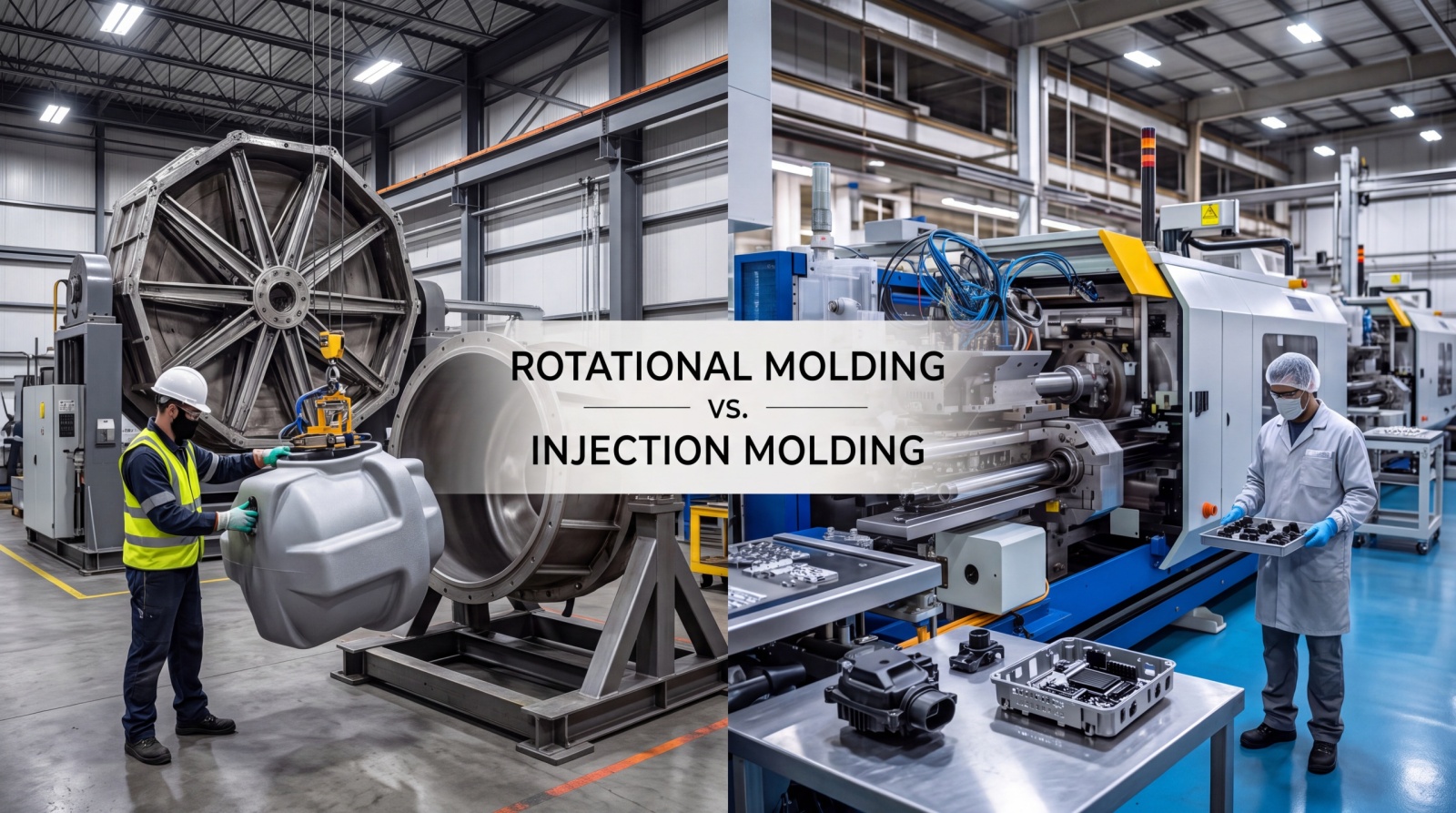
Rotational Molding vs Injection Molding: Which Process is Right for Your Product?
Compare tooling cost, production volume, part size, durability, materials and design considerations to determine which plastic manufacturing process best fits your product.
By RotationalMolding.com Editorial Team
Published August 10, 2026
Choosing the right plastic manufacturing process can determine far more than how a product is made. The decision can influence tooling investment, part durability, production volume, design freedom, wall thickness, material selection, lead time, assembly requirements, and the long-term economics of the entire product.
Two of the most widely discussed plastic manufacturing methods are rotational molding and injection molding.
Both processes can produce high-quality plastic components, but they solve very different manufacturing problems.
Injection molding is often the preferred choice for relatively small to medium-sized parts that must be produced rapidly and repeatedly in very large quantities. Rotational molding, also known as rotomolding, excels when products are large, hollow, seamless, durable, complex, or require comparatively economical tooling.
The right choice depends on the product—not on which process is more familiar.
Understanding the differences between rotational molding and injection molding early in product development can prevent costly tooling mistakes and help engineers select the manufacturing process that best supports the intended application.
Rotational Molding vs Injection Molding at a Glance
| Consideration | Rotational Molding | Injection Molding |
|---|---|---|
| Primary Strength | Large, Hollow, Seamless and durable products | High-volume precision production |
| Manufacturing Pressure | Low-Press/Essentially pressure-free forming | High-pressure injection |
| Typical tooling investment | Generally lower | Generally higher |
| Production speed | Longer molding cycles | Very fast once tooling is running |
| Ideal volumes | Low, moderate and many production applications | Usually strongest at high volumes |
| Large hollow products | Excellent | Often impractical or expensive |
| Seamless Construction | Excellent | Usually requires special design or assembly |
| Wall Thickness | Well suited to thicker durable walls | Commonly optimized for thinner walls |
| Fine surface detail | Good, application dependent | Excellent |
| Dimensional Precision | Good when properly engineered | Excellent for precision applications |
| Inserts | Can be molded into part | Can also incorporate inserts |
| Double-wall construction | Excellent design opportunity | More difficult |
| Tool complexity | Often comparatively simple | Can become highly complex |
| Material variety | More limited; Polyethylene dominates | Extremely broad |
| Tool Modifications | Often comparatively practical | Can be costly or difficult |
| Very high production quantities | Possible, but slower cycle time matters | Major advantage |
Neither process should automatically be considered “better.” Each becomes powerful when applied to the right product.
What Is Rotational Molding?
Rotational molding is a thermoplastic manufacturing process in which a measured quantity of plastic resin is placed inside a hollow mold. The mold is heated while rotating slowly on two axes, allowing the resin to melt and gradually coat the interior surface.
The mold continues rotating during controlled heating and cooling. Once the material has solidified, the mold is opened and the finished product is removed.
Unlike injection molding, rotational molding does not rely on extreme pressure to force molten plastic into a mold cavity. Instead, heat, gravity and biaxial rotation distribute the material throughout the mold. This low-pressure approach is one reason rotational molding tooling can often be less massive and less costly than tooling required for high-pressure processes.
The rotational molding process is particularly well suited for manufacturing:
- large hollow products
- seamless containers
- tanks
- material handling products
- industrial components
- double-wall products
- marine products
- outdoor products
- rugged enclosures
- transportation components
- safety products
- custom engineered plastic structures
Rotomolding is especially valuable when durability, part size, hollow geometry and relatively economical tooling are more important than producing thousands of parts per hour.
What is Injection Molding?
Injection molding begins by melting plastic resin and forcing the molten material under pressure into a closed mold cavity.
Once the cavity is filled, the plastic cools and solidifies. The mold opens, the part is ejected, and the cycle begins again.
The process can be extremely fast once a mold has been engineered and production parameters have been established. That makes injection molding exceptionally well suited for products requiring very large quantities of consistent parts.
Injection molding also offers excellent detail, repeatability and dimensional control when the product geometry, material and tooling are appropriately engineered. Injection mold design commonly involves careful management of wall thickness, draft, gates, ejector systems, cooling, parting lines and potential defects such as sink, warp or incomplete filling.
Common injection-molded products include:
- caps
- housings
- electronic components
- clips
- consumer products
- automotive components
- medical components
- small containers
- appliance components
- precision plastic parts
- high-volume industrial components
Injection molding is difficult to beat when a relatively compact part needs to be manufactured hundreds of thousands—or millions—of times.
The Most Important Difference: How the Plastic Enters the Mold
Perhaps the biggest difference between injection molding and rotational molding is pressure.
Injection molding uses substantial pressure to move molten material rapidly through runners, gates and the mold cavity.
Rotational molding does not.
During rotomolding, plastic resin melts against the inner surface of the mold while the mold rotates. The material gradually builds the wall of the product rather than being injected into the cavity all at once.
That difference affects nearly everything else:
- mold construction
- tooling cost
- product size
- wall thickness
- residual stresses
- design possibilities
- machine requirements
- production speed
It also explains why a part that is an excellent injection-molding candidate may be poorly suited for rotational molding—and vice versa.
Tooling Cost: One of Rotational Molding's Biggest Advantages
Tooling is often one of the first major financial decisions in a new plastic product.
Injection molds must withstand repeated high-pressure production cycles. Depending on part complexity, expected volume, cavity count, cooling requirements, sliders, lifters, inserts and other features, injection tooling can become highly sophisticated.
Rotational molds operate under much lower pressure.
As a result, rotational molding tools can often be fabricated or cast from aluminum or fabricated from steel without requiring the massive mold bases and high-pressure construction associated with injection molding.
The Association of Rotational Molders identifies comparatively low tooling cost as one of the important economic advantages of the rotomolding process, particularly for smaller production quantities.
This can make rotational molding attractive for:
- new product launches
- specialty industrial products
- limited production runs
- products with uncertain initial demand
- large parts
- products that may evolve after launch
A properly designed rotational mold can often be welded, machined, modified or repaired as a product evolves. Injection tooling can also be modified, but changes to hardened, highly engineered injection molds can become significantly more involved.
For a deeper look at tooling, visit our guide to molds for rotational molding.
Production Volume: Where Injection Molding Becomes Extremely Powerful
If your company needs several million small plastic components every year, injection molding deserves serious consideration.
Injection molding’s greatest economic advantage appears after the investment in tooling has been made.
Cycle times can be very short. Automated material handling, part removal, multi-cavity molds and sophisticated production equipment can produce enormous quantities efficiently.
This means a costly mold may become economical when its cost is distributed across hundreds of thousands or millions of pieces.
Rotational molding generally operates on a longer cycle.
The mold must be loaded, heated, rotated, cooled, opened and unloaded. A rotomolding cycle can therefore take significantly longer than an injection-molding cycle.
That doesn’t mean rotational molding is restricted to prototypes or tiny quantities.
Rotomolding is used commercially around the world for substantial ongoing production programs. However, if two processes can manufacture the same product equally well and the required volume is enormous, injection molding may have the economic advantage.
The real question is therefore not:
“Which process can make more parts?”
It is:
“Which process can manufacture this particular product at the best total cost while meeting its performance requirements?”
Part Size: A Major Rotational Molding Advantage
Large products can completely change the manufacturing equation.
Imagine trying to injection mold:
- a large industrial tank
- an oversized material handling container
- a large air cargo structure
- a heavy-duty outdoor enclosure
- a substantial marine component
The injection molding machine would need enough clamping force, shot capacity and mold capacity to handle the entire product.
That can quickly become impractical.
Rotational molding is renowned for its ability to manufacture very large hollow parts. ARM describes rotomolding as particularly well suited to relatively large, hollow, seamless products.
This is one of the reasons rotational molding is widely used for products such as:
- large storage tanks
- bulk containers
- commercial carts
- waste handling products
- playground structures
- agricultural tanks
- shipping containers
- marine products
- industrial housings
For large products, rotational molding should often be evaluated early rather than trying to adapt a design originally intended for another manufacturing process.
Hollow and Seamless Products
Rotational molding has another major advantage: it naturally produces hollow structures.
A rotational mold defines the outside geometry of the part while resin coats its interior surface.
The result can be a single-piece hollow component without the need to mold separate halves and weld, fasten or bond them together.
That eliminates potential failure points associated with:
- mechanical fasteners
- welded seams
- bonded joints
- separate shells
- multi-piece assembly
For products expected to hold liquids, resist weather or survive repeated impacts, eliminating seams can be extremely valuable.
This is one reason rotational molding is commonly selected for tanks, containers, bins and products designed for demanding environments.
Double-Wall Products and Structural Geometry
Rotational molding can also produce sophisticated double-wall structures.
A product can be designed with an external wall and an internal wall connected through molded geometry, strengthening ribs or kiss-off areas.
These structures can provide significant stiffness without requiring an entirely solid plastic section.
Double-wall rotational molding can be especially valuable for:
- pallets
- lids
- barriers
- enclosures
- doors
- material handling products
- furniture
- structural plastic components
Good rotational molding design uses geometry intelligently instead of simply adding more plastic.
That distinction matters.
A well-designed rotomolded product does not necessarily become stronger because its walls are made arbitrarily thick. Structural strength can often be improved through proper radii, ribs, transitions, double-wall geometry and reinforcement features.
Wall Thickness
Wall thickness is another area where the two processes differ considerably.
Injection molding generally favors relatively consistent, thinner wall sections because molten material must rapidly fill the cavity before solidifying.
Abrupt changes in thickness can contribute to problems such as sink, warp, uneven cooling and internal stress.
Rotational molding is often very comfortable producing thicker walls.
Because the material gradually builds against the mold surface rather than flowing rapidly through a thin cavity, designers can create rugged products with substantial wall sections.
Wall thickness can also sometimes be influenced locally through mold design and manufacturing technique.
However, rotomolded wall thickness is not controlled in exactly the same way as a precision injection-molded dimension.
Both processes benefit from careful engineering, but they behave differently.
This is why a CAD model should never simply be handed from one manufacturing process to another without review.
Product Durability
Rotational molding is particularly attractive for products expected to live a hard life.
Examples include products that are:
- dropped
- dragged
- stacked
- exposed to outdoor weather
- transported repeatedly
- struck by equipment
- exposed to water
- used in industrial environments
The process can produce thick, resilient plastic structures without welded seams.
Polyethylene—the most commonly used rotomolding material—is also valued for its impact resistance and environmental durability. ARM identifies polyethylene as the dominant rotational molding material.
Properly designed injection-molded products can also be extremely durable, of course.
Durability depends on:
- resin
- geometry
- wall thickness
- reinforcement
- operating environment
- UV exposure
- temperature
- loading
- impact conditions
The manufacturing process alone does not guarantee product performance.
What rotational molding provides is a very useful platform for engineering large, rugged hollow structures.
Material Selection
Injection molding offers an enormous selection of thermoplastics.
Because the process is used across such a broad spectrum of industries, injection molders commonly process materials ranging from commodity plastics to highly engineered polymers.
Rotational molding has a narrower practical material selection.
Polyethylene dominates because its thermal properties, durability and processing characteristics make it exceptionally well suited to rotomolding. Other polymers can also be rotationally molded depending on the application and process requirements.
This difference matters greatly.
If your product requires a highly specialized engineering polymer that does not process well rotationally, injection molding may be the stronger option.
If polyethylene delivers the required chemical resistance, impact strength, weatherability and performance, rotational molding may offer substantial advantages elsewhere in the project.
Material selection should therefore occur early in the development process.
Precision and Tolerances
Injection molding generally has the advantage when very tight dimensional control is essential.
The combination of rigid tooling, high-pressure filling and controlled processing can produce highly repeatable parts.
Rotational molding can also manufacture dimensionally consistent products, but engineers must account for:
- material shrinkage
- cooling
- mold geometry
- wall thickness
- part size
- post-mold behavior
Very large hollow plastic structures should not automatically be evaluated against the same tolerance expectations applied to a small precision injection-molded component.
The tolerance must match the function.
Over-specifying tolerances can add unnecessary cost regardless of manufacturing process.
Surface Detail and Appearance
Injection molding is capable of producing exceptionally fine cosmetic detail.
Texturing, lettering, logos and complex surface features can be engineered directly into the mold.
Rotational molding can also incorporate:
- molded lettering
- logos
- textures
- graphics
- part identification
- decorative surfaces
But the level of fine detail achievable may differ from injection molding depending on the material, mold construction and product geometry.
If microscopic detail, exceptionally sharp edges or a highly controlled cosmetic surface is central to the product, injection molding may deserve an advantage.
If the product requires durable commercial-grade aesthetics rather than microscopic detail, rotational molding may perform extremely well.
Inserts and Molded-In Features
Rotational molding can incorporate many useful features during manufacturing.
Examples include:
- threaded inserts
- mounting points
- molded handles
- recessed areas
- graphics
- attachment locations
- structural features
ARM specifically notes that rotomolding can incorporate handles, threads, graphics and inserts directly into product design.
Injection molding can also use insert molding and sophisticated mold features.
The difference again comes down to the product.
The question is not whether either process can incorporate inserts.
The question is which manufacturing strategy produces the required feature at the best combination of reliability, tooling investment and production cost.
Undercuts and Complex Geometry
Rotational molding often provides substantial geometric freedom.
Because the molded part is relatively flexible when removed from the tool, some geometries that would require complicated tooling in another process may be achievable through thoughtful rotomolding design.
Injection molding has stricter requirements related to part ejection.
Undercuts may require:
- sliders
- lifters
- collapsible cores
- secondary tooling actions
- redesign
Each mechanism can add mold complexity and cost.
That does not mean rotational molding has unlimited design freedom. A product must still be removable from the mold.
Successful design requires an engineer who understands the manufacturing process.
Part Consolidation: An Often-Overlooked Opportunity
One of the greatest potential advantages of rotational molding is not simply replacing an injection-molded part.
It is replacing an entire assembly.
Consider a product that currently requires:
- two plastic shells
- several brackets
- multiple fasteners
- seals
- welding
- assembly labor
A rotationally molded redesign may sometimes combine much of that assembly into one large hollow structure.
That can reduce:
- part count
- inventory
- assembly labor
- fastening hardware
- leak paths
- service problems
- manufacturing complexity
This is where process selection becomes much more interesting than comparing price per pound of plastic.
A product should be evaluated as an entire system.
Rotational Molding May Be the Better Choice When...
Rotational molding deserves serious consideration when your product:
- is large
- is hollow
- requires seamless construction
- requires thick durable walls
- requires double-wall construction
- will experience substantial impact
- will be exposed outdoors
- requires comparatively economical tooling
- will be produced in low or moderate quantities
- may require future design changes
- can benefit from molded-in inserts or hardware
- currently requires multiple assembled components
- needs a strong polyethylene construction
If several of these conditions apply, learn more about why rotational molding may be appropriate for the application.
Injection Molding May Be the Better Choice When...
Injection molding deserves serious consideration when your product:
- is relatively small
- requires extremely large annual quantities
- needs very short production cycles
- requires exceptionally tight dimensional tolerances
- contains very fine features
- requires thin-wall construction
- requires specialized injection-grade engineering resins
- can economically justify sophisticated tooling
- must be produced in multi-cavity molds at very high rates
In these situations, the higher initial tooling investment may be offset by extremely efficient production.
What About Products That Could Be Made Either Way?
This is where the decision becomes more sophisticated.
Some products can technically be manufactured through either process.
Imagine a hollow housing.
Injection molding might produce the housing as two separate halves that are later assembled.
Rotational molding might produce it as one hollow structure.
Which is better?
You would need to compare:
- injection mold cost
- rotational mold cost
- annual production requirements
- assembly labor
- fastening costs
- leak potential
- durability
- material requirements
- dimensional tolerance
- cycle time
- secondary operations
- packaging
- shipping
- lifecycle cost
This is why manufacturing decisions should be made using total product economics, not merely piece price.
Tooling Cost vs Part Cost
A simple comparison might look like this:
Injection Molding
Higher tooling investment
- lower high-volume cycle cost
- extremely fast production = potentially excellent economics at high quantities
Rotational Molding
Lower tooling investment
- longer cycle time
- strong part consolidation opportunities = potentially excellent economics for large, hollow, complex or moderate-volume products
Neither equation is universal.
For a more detailed breakdown of tooling, material, machine time, labor, cycle time, secondary operations, production volume and other manufacturing variables, see our guide to how much rotational molding costs
A high-volume product may still belong in rotational molding because it cannot practically be injection molded.
Likewise, a modest-volume product may still belong in injection molding if its geometry or material requires it.
Don't Choose the Manufacturing Process Too Late
One of the most expensive product-development mistakes is completing the design before selecting the manufacturing process.
A product optimized for machining may not be optimized for molding.
A product designed for injection molding may not take advantage of rotational molding.
And a product intended for rotomolding should not simply imitate the geometry of an injection-molded component.
Manufacturing should influence the design from the beginning.
Our rotational molding design process evaluates product geometry, materials, wall thickness, structural loading, tooling strategy, inserts, secondary operations and long-term performance before tooling begins.
Early collaboration can prevent costly redesign after a mold has already been produced.
Consider the Product's Entire Life Cycle
The cheapest manufacturing process is not necessarily the process with the lowest initial quotation.
Product developers should consider:
- tooling investment
- expected annual volume
- tooling maintenance
- assembly labor
- scrap
- product durability
- warranty exposure
- freight
- replacement frequency
- design revisions
- inventory requirements
- production flexibility
For example, spending less per part may not be valuable if the product requires additional welding, assembly and hardware.
Similarly, choosing inexpensive tooling may not be wise if annual production demand vastly exceeds the economic capacity of the process.
The strongest manufacturing decisions balance tooling, production and lifetime product performance.
A Simple Decision Framework
Ask these questions before selecting a process:
1. How large is the product?
Very large hollow components often favor rotational molding.
2. Is the product hollow?
If yes, rotomolding should strongly be considered.
3. Does it need to be seamless?
Seamless construction is a major strength of rotational molding.
4. What annual production quantity is expected?
Extremely high production generally strengthens the case for injection molding.
5. How much tooling investment can the program justify?
Rotational molding often offers a lower barrier to tooling.
6. How precise must the dimensions be?
Very tight tolerances may favor injection molding.
7. What material is required?
Specialized engineering polymers may influence the process choice.
8. Is durability more important than minimum wall thickness?
Rugged products often align well with rotomolding.
9. Can several assembled components become one molded product?
If yes, rotational molding deserves serious evaluation.
10. Will the design likely change?
Rotational molds can often offer comparatively practical modification opportunities.
Rotational Molding vs Injection Molding: Which One Wins?
Neither.
The product wins when the correct manufacturing process is selected.
Injection molding is an extraordinary manufacturing process for producing tremendous quantities of precise plastic components quickly and consistently.
Rotational molding is an extraordinary process for manufacturing large, hollow, seamless, durable and complex plastic structures with comparatively economical tooling and exceptional design flexibility.
Trying to force every plastic product into one process is poor engineering.
The goal should be to understand the product’s performance requirements and then select the manufacturing technology that supports them most effectively.
Could Your Injection-Molded Product Be Better as a Rotomolded Product?
Sometimes the best opportunity is not designing a new product.
It is redesigning an existing one.
Products originally manufactured from:
- multiple injection-molded components
- fabricated plastics
- welded plastic sheets
- fiberglass
- metal
- wood
- assembled housings
may sometimes be consolidated into a rotationally molded design.
Potential advantages can include:
- fewer components
- reduced assembly
- improved impact resistance
- elimination of corrosion
- reduced maintenance
- seamless construction
- lower tooling investment
- improved product longevity
A proper conversion analysis should evaluate the complete product—not simply recreate the existing geometry in plastic.
Work With a Rotational Molder Before Investing in Tooling
If you are comparing injection molding with rotational molding, the best time to involve a rotational molding specialist is before the product design becomes locked.
An experienced rotational molder can evaluate:
- geometry
- expected volume
- tooling strategy
- material
- wall thickness
- inserts
- structural requirements
- assembly opportunities
- secondary operations
- manufacturing feasibility
Granger Plastics provides custom rotational molding support from initial product evaluation and design through tooling, manufacturing and secondary operations.
With in-house engineering and an integrated mold and metal fabrication shop, product development can be evaluated as a complete manufacturing program rather than a collection of disconnected services.
Frequently Asked Questions
Is rotational molding cheaper than injection molding?
Rotational molding often requires a lower initial tooling investment, particularly for large hollow products and moderate production volumes. Injection molding can achieve extremely low unit costs once high production volumes justify its more expensive tooling.
Is injection molding faster than rotational molding?
Yes. Injection molding generally has much shorter cycle times and is exceptionally efficient for high-volume production.
Can rotational molding produce large parts?
Yes. Large hollow parts are one of rotational molding’s greatest strengths.
Can rotational molding create complex shapes?
Yes. Rotational molding can produce complex hollow geometries, double-wall structures, molded-in features and integrated inserts when the part is correctly designed for the process.
Which process produces stronger parts?
Strength depends on material, geometry, wall thickness, loading and design. Rotational molding is particularly well suited to thick-wall, impact-resistant, seamless products, while injection molding can produce extremely strong engineered components using a very broad selection of resins.
Which process has cheaper molds?
Rotational molding tooling is generally less expensive because the process does not require the tooling to withstand the extremely high pressures associated with injection molding.
Is rotational molding good for high-volume manufacturing?
Yes, rotational molding is used for significant commercial production. However, because its cycles are generally longer than injection molding, injection molding can have an economic advantage when a suitable small or medium-sized part must be produced in extremely large quantities.
Can an injection-molded product be converted to rotational molding?
Potentially. A conversion evaluation should consider geometry, material, product size, annual volume, assembly, wall thickness and performance requirements.
Find the Right Manufacturing Process Before You Build the Mold
Choosing between injection molding and rotational molding should happen before major tooling investments are made.
If your product is large, hollow, durable, seamless or manufactured in quantities that make expensive injection tooling difficult to justify, rotational molding may provide a compelling alternative.
The engineering team at Granger Plastics can evaluate your product concept, existing component or manufacturing challenge and help determine whether rotomolding is appropriate.
Explore our complete rotational molding capabilities, learn more about the rotational molding process, or request a rotational molding quote to discuss your application.