
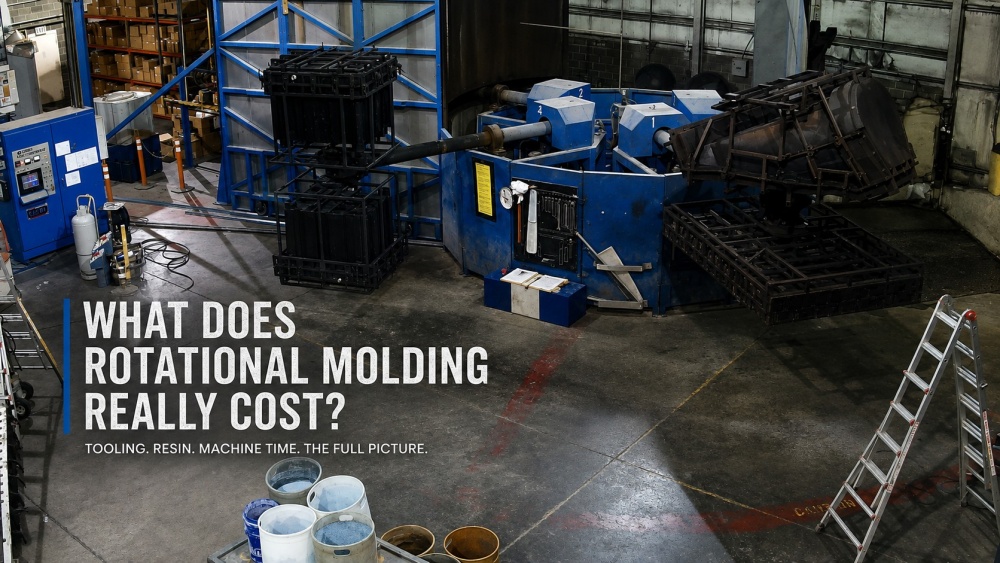
How Much Does Rotational Molding Cost? Tooling, Part Price & Production Factors Explained
Understanding the true cost of rotational molding requires more than simply multiplying resin cost by a factor. Learn how tooling, cycle time, labor, machine utilization, part complexity, secondary operations, volume and other manufacturing requirements influence the real cost of a rotomolded product.
By RotationalMolding.com Editorial Team
Published August 14, 2026
One of the most common questions asked during the early stages of a plastic manufacturing project is also one of the most difficult to answer with a single number:
How much does rotational molding cost?
The answer depends on much more than the amount of plastic contained in the finished product.
Tooling, material consumption, machine time, cycle length, labor, mold complexity, part geometry, inserts, trimming, assembly, testing, packaging, production quantity and numerous other variables can influence the true manufacturing cost of a rotationally molded product.
This is why two rotomolded products containing nearly the same weight of polyethylene can have significantly different manufacturing costs.
A proper rotational molding quotation should therefore evaluate the resources actually required to manufacture the product—not simply apply an arbitrary multiplier to the cost of resin.
Understanding how those costs are created can help engineers, purchasing professionals and product developers make better decisions before investing in tooling or committing to a manufacturing process.
There Is No Universal Price for Rotational Molding
It would be convenient if rotational molding could be priced using a simple formula such as:
Part weight × resin price = finished product price
Real manufacturing does not work that way.
Material is certainly an important component of cost, but it is only one part of the equation.
A relatively simple rotomolded product might require:
- one uncomplicated mold
- minimal labor
- a predictable heating cycle
- limited cooling time
- very little trimming
- no inserts
- no assembly
- no testing
- straightforward packaging
Another product containing approximately the same amount of plastic might require:
- a complex multi-piece mold
- multiple threaded inserts
- longer heating and cooling cycles
- additional mold preparation
- extensive trimming
- secondary machining
- assembly
- quality inspections
- pressure or leak testing
- specialized packaging
The resin weight may be similar.
The actual manufacturing requirements are not.
That distinction is critical when evaluating the true economics of rotational molding.
Why Price-Per-Pound Can Be Misleading
A common shortcut in plastics manufacturing is to estimate selling price largely from material cost.
The logic may appear reasonable:
Determine the amount of resin in the product, calculate the raw material cost and multiply it by a predetermined factor.
That approach may provide a quick estimate, but it can significantly oversimplify the true cost of manufacturing a rotationally molded product.
Consider two hypothetical products that each require 100 pounds of polyethylene.
Product A
Product A:
- uses a simple mold
- requires minimal mold preparation
- heats evenly
- cools predictably
- requires little trimming
- contains no inserts
- requires no assembly
- has a relatively efficient production cycle
Product B
Product B:
- uses a complicated mold
- contains several inserts
- requires additional mold preparation
- has challenging geometry
- requires substantially more heating and cooling time
- needs significant trimming
- requires machining and assembly after molding
- requires additional quality inspection
Both products contain 100 pounds of resin.
Yet Product B consumes considerably more manufacturing resources.
Pricing both products using the same resin multiplier would ignore much of the actual cost difference between them.
A more disciplined approach evaluates what the product truly requires from the manufacturing operation.
What Actually Determines the Cost of a Rotomolded Part?
The price of a rotationally molded product is typically influenced by several major categories.
- Raw material
- Machine and production time
- Cycle time
- Labor
- Tooling
- Mold complexity
- Part geometry
- Secondary operations
- Inserts and hardware
- Quality requirements
- Production volume
- Packaging and logistics
The importance of each category depends on the product.
1. Raw Material and Resin Consumption
Material is one of the most visible components of rotational molding cost.
Polyethylene is the most widely used material in rotational molding, although other polymers and specialized material systems may be appropriate depending on the application.
The amount of material required is influenced by:
- finished part weight
- wall thickness
- product dimensions
- structural requirements
- required impact resistance
- expected loading
- material density
- scrap allowances
- color requirements
- additives
- UV stabilization
- specialty resin requirements
For a very large industrial product, material may represent a substantial portion of the manufacturing cost.
However, resin alone does not determine selling price.
This is one reason engineers should avoid unnecessarily increasing wall thickness simply to make a product “stronger.”
Good rotational molding design often uses geometry, radii, ribs, double-wall construction and structural features to achieve performance without simply adding more pounds of plastic.
2. Machine Time
Machine utilization is one of the most important—and frequently overlooked—components of rotational molding cost.
A rotational molding machine is a valuable manufacturing asset.
While a mold occupies a machine arm or production station, that equipment cannot be used for another mold in the same location.
Manufacturing cost therefore must account for the amount of equipment capacity consumed by the product.
Two parts of similar weight may occupy dramatically different amounts of machine time.
One might complete its production cycle relatively quickly.
Another may require a substantially longer heating and cooling period.
The second product consumes more production capacity even if both products use the same amount of resin.
A realistic costing system must therefore evaluate machine utilization, not simply raw material consumption.
3. Rotational Molding Cycle Time
The rotational molding process requires several distinct stages.
A typical production cycle may include:
- mold preparation
- material loading
- mold closing
- oven heating
- biaxial rotation
- material fusion
- cooling
- mold opening
- part removal
- preparation for the next cycle
The amount of time required for these steps can vary significantly.
Cycle time can be influenced by:
- part size
- wall thickness
- mold material
- mold thickness
- product geometry
- resin type
- oven temperature
- airflow
- cooling method
- ambient conditions
- mold design
- required material cure or fusion
- insert configuration
A long cycle consumes more manufacturing capacity and therefore generally contributes more cost than a shorter cycle.
This is true even when both parts contain the same amount of plastic.
4. Labor Requirements
Rotational molding is not simply a machine operating by itself.
Labor may be required throughout the production process.
Depending on the product, manufacturing labor can include:
- mold preparation
- material loading
- insert placement
- mold closing
- machine operation
- mold opening
- part removal
- trimming
- drilling
- routing
- assembly
- welding
- hardware installation
- inspection
- testing
- packaging
A simple part requiring minimal handling naturally has a different cost structure from a product that requires significant post-mold labor.
This is another reason material-only pricing can be misleading.
5. Tooling Cost
The cost of the mold is one of the largest up-front investments in many rotational molding projects.
Rotational molds may be:
- cast aluminum
- fabricated aluminum
- fabricated steel
- CNC machined
- constructed from multiple sections
- designed with removable components
- fitted with inserts, hardware or specialty features
The cost of a rotational mold depends on factors such as:
- product size
- geometry
- mold material
- surface requirements
- number of mold sections
- complexity
- tolerances
- parting lines
- internal features
- structural support
- frame construction
- venting
- machining
- finishing
Learn more about molds for rotational molding and the factors that influence tooling design and long-term mold performance.
For a more detailed look at how product size, geometry, mold construction and manufacturability influence the initial tooling investment, see our guide to how much a mold for rotational molding costs.
How Much Does a Rotational Molding Mold Cost?
There is no universal mold price.
A relatively simple mold for a small product may cost dramatically less than a large, complex industrial tool with multiple sections, extensive machining and structural support.
This is why quoting tooling based solely on product dimensions can be misleading.
The mold must be evaluated as an engineered manufacturing tool.
Factors that affect tooling investment include:
- mold size
- mold complexity
- aluminum versus steel construction
- CNC machining requirements
- surface texture
- parting-line design
- removable mold sections
- hardware
- support frames
- internal structures
- production life expectancy
- maintenance requirements
Tooling cost should also be evaluated over the expected life of the product.
A properly engineered mold may produce parts for many years.
For that reason, the lowest initial tooling quote is not always the lowest long-term manufacturing cost.
6. Mold Complexity
Complex tooling generally requires more labor to operate.
A simple two-piece mold may open and close quickly.
A complicated mold might require:
- multiple clamps
- removable sections
- internal cores
- insert placement
- specialized handling
- additional mold preparation
- more careful demolding
Each additional operation consumes labor and production time.
Complex mold geometry can also influence heating and cooling behavior, affecting cycle time.
Therefore, tooling complexity can affect both the initial mold investment and the ongoing cost of manufacturing each part.
7. Product Geometry
The geometry of the product itself affects manufacturing cost.
Important design factors include:
- overall dimensions
- wall thickness
- depth
- undercuts
- narrow passages
- sharp transitions
- corners
- ribs
- double-wall features
- kiss-offs
- mounting features
- inserts
- parting-line location
A product designed specifically for rotational molding can often be manufactured more efficiently than a product that was originally designed for another process and later adapted.
This is why manufacturers should involve a rotational molding engineer early in development.
A thoughtful design can reduce:
- tooling complexity
- material use
- cycle time
- secondary operations
- assembly requirements
- production problems
Those improvements can influence manufacturing cost over the entire life of the program.
8. Inserts and Molded-In Hardware
Rotational molding can incorporate inserts and other features directly into the molding process.
These may include:
- threaded inserts
- metal plates
- mounting points
- studs
- brackets
- reinforcement components
Each insert introduces both material and labor requirements.
Operators may need to position and secure the inserts before every molding cycle.
The insert itself also has a cost.
Products containing numerous molded-in components therefore require a different cost evaluation than products made entirely from polyethylene.
9. Secondary Operations
The rotational molding cycle may produce the primary plastic structure, but many products require additional manufacturing operations.
These can include:
- trimming
- routing
- drilling
- machining
- welding
- assembly
- hardware installation
- graphics
- labeling
- leak testing
- pressure testing
- inspection
- packaging
Secondary operations can represent a meaningful portion of total product cost.
For some products, the molded part may be relatively straightforward while the secondary manufacturing process is extensive.
A complete quotation must account for both.
10. Quality and Testing Requirements
Not every rotationally molded product requires the same level of inspection or testing.
Some products may require basic visual inspection.
Others may require:
- dimensional inspection
- wall-thickness verification
- leak testing
- pressure testing
- load testing
- hardware verification
- documentation
- traceability
- specialized quality procedures
Products used in demanding industrial, transportation, aerospace or safety applications may require more extensive quality controls than general consumer products.
Those requirements influence production cost.
11. Production Volume
Production quantity plays an important role in rotational molding economics.
The cost structure for ten parts is different from the cost structure for ten thousand parts.
Higher production quantities may provide opportunities to improve:
- material purchasing
- scheduling efficiency
- mold utilization
- labor efficiency
- production planning
- secondary operations
- packaging
- inventory management
However, production volume should never be considered independently of product size and cycle time.
A product requiring significant machine capacity may remain expensive to manufacture even at high quantities.
Conversely, a well-designed product with efficient tooling may achieve attractive economics at moderate volumes.
For projects that might also be candidates for another molding technology, our guide to rotational molding vs. injection molding explains how production volume, tooling investment, part size and manufacturing speed influence process selection.
12. Packaging and Logistics
Large rotationally molded products can introduce another important consideration: shipping.
A product may be lightweight relative to its physical size but consume significant freight volume.
Packaging requirements might include:
- pallets
- protective wrapping
- cartons
- custom crating
- stacking systems
- freight preparation
- special handling
Shipping economics can sometimes influence product design.
Products that nest, stack or ship efficiently may create meaningful cost savings beyond the molding operation itself.
Tooling Cost and Part Cost Are Two Different Decisions
Product developers should separate two major cost questions:
How much will the mold cost?
and
How much will each finished product cost?
These are related, but they are not the same.
Tooling represents the initial manufacturing investment.
Part cost reflects the ongoing resources necessary to produce each product.
A project with inexpensive tooling may still have a relatively high part cost if production is labor-intensive or cycles are long.
Conversely, a more sophisticated mold may reduce production labor, improve cycle efficiency or eliminate secondary operations.
The correct decision should evaluate the entire manufacturing program rather than simply choosing the least expensive mold.
Why the Cheapest Mold May Not Produce the Cheapest Product
Tooling decisions have long-term consequences.
A poorly engineered mold may create:
- longer cycle times
- difficult demolding
- inconsistent wall thickness
- additional trimming
- increased scrap
- excessive labor
- maintenance problems
- quality issues
Those costs repeat every time a product is manufactured.
A better tool may require greater investment initially but reduce manufacturing costs over thousands of production cycles.
For this reason, tooling should be evaluated as a long-term manufacturing asset rather than simply an up-front expense.
How Part Design Can Reduce Rotational Molding Cost
Engineering decisions made before tooling can have an enormous impact on long-term manufacturing cost.
Potential design improvements may include:
- reducing unnecessary wall thickness
- improving corner radii
- simplifying mold construction
- eliminating difficult undercuts
- reducing the number of mold sections
- improving material flow
- integrating structural geometry
- eliminating separate components
- reducing secondary operations
- incorporating molded-in features
- improving stackability or nesting
An experienced rotational molder can often identify cost-reduction opportunities before the mold is built.
This is one of the primary advantages of involving the manufacturer early rather than completing the product design independently and requesting a quotation afterward.
Learn more about designing products for rotational molding.
Part Consolidation Can Change the Entire Cost Equation
One of the biggest potential economic advantages of rotational molding is the ability to replace multiple components with one molded structure.
Consider an existing product consisting of:
- two plastic shells
- brackets
- fasteners
- seals
- welded joints
- assembly labor
A redesigned rotomolded version may sometimes combine several of those components into a single hollow product.
That can reduce:
- part count
- inventory
- assembly time
- hardware
- welding
- leak paths
- quality issues
- maintenance
In these situations, evaluating only the molding cost misses the larger economic opportunity.
The correct comparison is total manufactured product cost.
Rotational Molding Cost vs. Injection Molding Cost
Rotational molding and injection molding have very different economic structures.
Injection molding often requires a larger tooling investment but can achieve extremely fast production cycles and very low part costs at high volumes.
Rotational molding generally offers:
- lower-pressure tooling
- lower tooling investment for many applications
- large-part capability
- hollow construction
- seamless products
- thick durable walls
- strong part-consolidation opportunities
The correct process depends on the product.
A high-volume precision component may strongly favor injection molding.
A large hollow product may strongly favor rotational molding regardless of annual quantity.
Our complete rotational molding vs. injection molding comparison examines the tradeoffs in greater detail.
Why Accurate Costing Matters
Manufacturers must make pricing decisions every day.
A simplified pricing model may be convenient, but convenience and accuracy are not the same thing.
A true manufacturing costing structure attempts to understand what resources a product actually consumes.
That includes:
- material
- equipment
- labor
- tooling
- processing time
- secondary operations
- quality requirements
- overhead
- packaging
- logistics
Accurate costing benefits both manufacturer and customer.
It helps prevent one product from subsidizing another and gives manufacturers a clearer understanding of where efficiency improvements can actually reduce cost.
It also allows product developers to make better decisions about design changes, production volume and tooling investment.
What Information Is Needed to Quote a Rotationally Molded Product?
The more complete the information provided, the more accurately a rotational molding project can be evaluated.
Useful information may include:
- CAD files
- drawings
- product dimensions
- expected annual volume
- required material
- target wall thickness
- product weight
- operating environment
- loading requirements
- inserts
- hardware
- tolerances
- cosmetic requirements
- testing requirements
- secondary operations
- packaging requirements
- existing tooling information
If the product already exists, photographs and samples may also be helpful.
What If the Product Has Never Been Rotationally Molded Before?
That is common.
Many successful rotational molding programs begin as:
- metal fabrications
- fiberglass products
- injection-molded assemblies
- welded plastic structures
- thermoformed components
- wood products
- multi-piece assemblies
The goal should not necessarily be to reproduce the existing product exactly.
Instead, the manufacturer should evaluate whether rotational molding offers opportunities to improve:
- durability
- manufacturing efficiency
- part consolidation
- corrosion resistance
- assembly
- maintenance
- tooling cost
- product life
A proper custom rotational molding evaluation considers both manufacturing feasibility and the total economics of the finished product.
Frequently Asked Questions About Rotational Molding Cost
Is rotational molding expensive?
Rotational molding can be extremely economical for the right type of product, particularly large, hollow, durable or moderate-volume parts. Cost depends on tooling, material, machine time, labor, product complexity and secondary operations. Companies evaluating process economics should also consider rotational molding vs. injection molding because tooling investment, production volume and part design can significantly affect which process is more economical.
How much does a rotational molding mold cost?
Mold cost varies widely depending on size, construction method, geometry, material, machining requirements and complexity. There is no universal tooling price.
Is rotational molding cheaper than injection molding?
It can be. Rotational molding often requires a lower initial tooling investment, particularly for large hollow products. Injection molding may achieve lower unit costs for smaller products manufactured in very large quantities.
Does resin price determine the cost of a rotomolded part?
Resin is an important cost component, but it does not determine total manufacturing cost by itself. Machine time, labor, cycle time, tooling, secondary operations and quality requirements can also have substantial effects.
Does a heavier rotomolded product always cost more?
Not necessarily. A heavier but simple product may be less expensive to manufacture than a lighter product requiring complicated tooling, long cycles, multiple inserts and extensive secondary operations.
Does higher production volume reduce rotational molding cost?
Higher production quantities can improve manufacturing efficiencies, but the impact depends on the product, tooling, machine utilization and cycle time.
Can product design reduce rotomolding cost?
Absolutely. Design changes that simplify tooling, reduce material consumption, eliminate secondary operations or improve cycle efficiency can reduce manufacturing cost throughout the life of the product.
Can rotational molding replace multiple assembled parts?
Yes. Part consolidation is one of the major opportunities rotational molding can provide. Several components may sometimes be redesigned as a single hollow molded structure.
The Most Important Question Is Not “What Does Rotational Molding Cost?”
A better question is:
What does this specific product truly require to manufacture correctly?
That is where meaningful costing begins.
The correct rotational molding price should reflect the actual resources required to manufacture the product—not simply the weight of resin multiplied by an arbitrary factor.
When tooling, product design, machine utilization, labor, cycle time, secondary operations and production quantity are evaluated together, manufacturers and customers can make far better long-term decisions.
Evaluate Your Rotational Molding Project
Every rotationally molded product has a unique manufacturing cost structure.
Granger Plastics evaluates custom rotational molding programs by considering the entire manufacturing process, including tooling, materials, product geometry, production requirements, labor, secondary operations and expected volume.
If you are developing a new product, converting an existing manufacturing process or evaluating the economics of a current plastic component, early collaboration can help identify opportunities before tooling investment begins.
Explore our custom rotational molding capabilities, learn more about the rotational molding process, review our approach to rotational molding design, or request a rotational molding quote to discuss your application.