

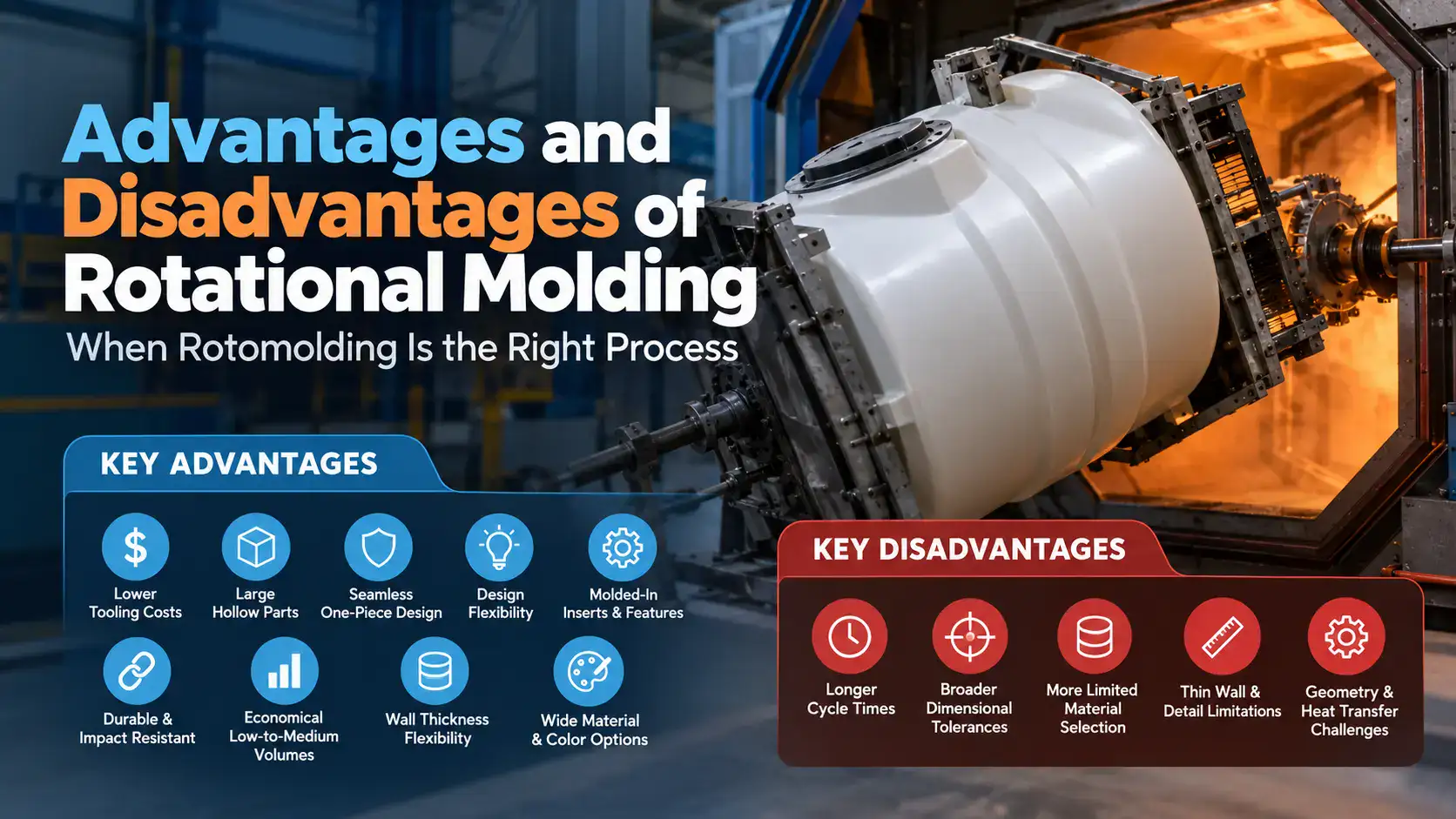
Advantages and Disadvantages of Rotational Molding: When Rotomolding Is the Right Process
Key Differences in Tooling, Production Volume, Part Size, Wall Thickness, Materials and Design Flexibility
By RotationalMolding.com Editorial Team
Published October 30, 2026
Choosing the right plastics manufacturing process requires understanding the advantages and disadvantages of rotational molding, along with how product size, geometry, production volume, tooling investment, material requirements, dimensional tolerances and expected service conditions affect whether a process makes practical and economic sense.
Rotational molding, also known as rotomolding, offers a unique combination of design flexibility, relatively low tooling costs and the ability to manufacture large, hollow and seamless plastic products. At the same time, the process has limitations that should be understood before a product is designed around it.
The following guide examines the major advantages and disadvantages of rotational molding from a practical manufacturing perspective and explains when rotomolding may—or may not—be the right process for a particular application.
Advantages and Disadvantages of Rotational Molding at a Glance
| Advantages | Limitations |
|---|---|
| Relatively low tooling costs | Longer molding cycles |
| Large hollow parts can be produced | Broader dimensional tolerances than some processes |
| Seamless one-piece construction | More limited material selection |
| Complex shapes and contours | Very thin walls can be challenging |
| Low-pressure molding process | Fine details may be difficult to reproduce |
| Molded-in inserts and features | Heat transfer and geometry affect material distribution |
| Excellent durability with proper materials | Not usually ideal for extremely high-volume small parts |
| Economical for many low-to-medium volume programs | Process development may be required for difficult geometry |
Advantages of Rotational Molding
1. Relatively Low Tooling Costs
One of the most important advantages of rotational molding is the cost of tooling. Rotomolding is a low-pressure process, so molds do not need to withstand the enormous pressures associated with processes such as injection molding.
Depending on the size, geometry, production requirements and expected mold life, rotational molds may be fabricated from aluminum, steel or cast aluminum. This can make tooling significantly more economical for large products and lower-to-medium production volumes.
The difference becomes especially important when producing very large plastic components. An injection mold for a large part can require an enormous tooling investment, while rotational molding may allow the same general product concept to be manufactured with substantially simpler tooling.
Learn more about tooling considerations in our guide, How Much Does a Rotational Mold Cost?
2. Large Hollow Parts Can Be Manufactured
Rotational molding is particularly well suited for large hollow plastic products. Tanks, containers, marine products, material-handling equipment, agricultural components and large industrial products are common examples.
Because the process does not require high-pressure injection equipment to force molten plastic through a mold cavity, very large parts can often be manufactured without the extreme machine tonnage required by other molding methods.
This ability to produce large hollow products is one of the reasons rotational molding remains an important manufacturing process for applications that would otherwise require fabrication, welding or assembly of multiple components.
3. Seamless One-Piece Construction
Rotationally molded products are typically manufactured as a single hollow component rather than two molded halves that must later be welded or mechanically assembled.
Eliminating seams can provide important advantages for tanks, containers and other products where durability, leak resistance or structural integrity are important.
One-piece construction can also reduce secondary assembly operations and eliminate potential failure points associated with fasteners, welded seams and bonded joints.
4. Design Flexibility
Rotational molding can produce complex shapes, curves, contours, recesses and hollow geometries that may be difficult to fabricate using conventional methods.
Designers can incorporate features such as:
- Ribs and reinforcing geometry
- Molded-in handles
- Mounting features
- Threads
- Metal inserts
- Textured surfaces
- Logos and molded lettering
- Complex internal and external contours
However, good rotational molding design still requires an understanding of resin flow, heat transfer, mold release and material distribution. Complex geometry does not automatically mean every feature will mold successfully.
Our rotational molding design guide discusses many of these considerations in greater detail.
5. Low-Pressure Processing
Unlike injection molding, rotational molding does not depend on high pressure to force molten plastic into a mold cavity. Material is gradually distributed across the interior mold surface as the mold rotates through the heating cycle.
This low-pressure process contributes to lower tooling requirements and can also allow relatively large molds to be manufactured without the massive clamping structures required by high-pressure processes.
For a detailed explanation of the manufacturing cycle, see our guide to the rotational molding process.
6. Molded-In Inserts and Other Features
Metal inserts, threaded fittings and other components can often be incorporated directly into a rotationally molded product.
When properly designed and processed, molded-in inserts may reduce secondary assembly and provide strong attachment points for hardware, brackets or other components.
Insert design requires attention to thermal expansion, material shrinkage, geometry and placement. Not every insert should automatically be molded into the part; in some applications, secondary installation methods may be more appropriate.
7. Durable Products and Excellent Impact Performance
Polyethylene materials commonly used in rotational molding can provide excellent durability, impact resistance and environmental performance when the correct resin is selected for the application.
LLDPE and MDPE are widely used because they offer a useful combination of toughness, processing characteristics, flexibility and impact performance. HDPE may be appropriate where additional rigidity or particular chemical-performance characteristics are required.
Material selection should always consider the actual application rather than simply selecting the resin with the highest value on a technical datasheet.
For more information, see our guide to rotational molding polyethylene and resin selection.
8. Wall Thickness Can Be Adjusted Without Redesigning the Entire Tool
In many rotational molding applications, wall thickness can be changed by adjusting the amount of material charged into the mold rather than machining an entirely new mold cavity.
That flexibility can be useful during product development or when different product versions require different nominal wall thicknesses.
However, increasing the resin charge does not guarantee perfectly uniform material distribution. Geometry, mold temperature, resin characteristics and processing conditions all influence the final wall.
Learn more in our technical guide to rotational molding wall thickness.
9. Well Suited for Low-to-Medium Production Volumes
Rotational molding can offer an attractive balance between tooling investment and production economics for low-to-medium volume products.
An injection-molded component may have a faster individual cycle, but the initial cost of the mold and equipment required to produce a large component can be substantially higher.
For programs that do not require hundreds of thousands or millions of identical parts, rotational molding can offer a much more practical manufacturing path.
Disadvantages and Limitations of Rotational Molding
Understanding the advantages and disadvantages of rotational molding is important because no manufacturing process is ideal for every application.
1. Longer Cycle Times
Rotational molding cycles generally take longer than high-speed processes such as injection molding.
The mold must be loaded, heated while rotating, cooled while rotation continues, opened, unloaded and prepared for the next cycle. Large molds and heavy-wall products may require substantial heating and cooling time.
For extremely high-volume products where seconds of cycle time dramatically affect unit cost, another molding process may be more economical.
2. Dimensional Tolerances Are Generally Broader
Rotational molding does not normally produce the extremely tight dimensional tolerances associated with precision injection molding or machining.
The plastic material shrinks as it cools, and the finished part can be influenced by geometry, wall thickness, cooling rate, resin characteristics and mold construction.
Experienced molders can control many of these variables, but a product requiring extremely tight precision across every dimension may not be an ideal rotational molding application.
3. Material Selection Is More Limited
Polyethylene dominates rotational molding because it combines suitable processing behavior with excellent physical properties and a relatively forgiving processing window.
Other materials can be rotationally molded, but the range of commercially practical materials is smaller than what may be available for injection molding.
Material must be capable of surviving an extended heating cycle while also flowing, melting and consolidating properly against the mold surface.
4. Very Thin Walls Can Be Difficult
Extremely thin-wall products can be challenging because rotational molding relies on powdered resin flowing and adhering to the heated mold surface rather than being forced into the cavity under pressure.
Thin sections may become especially difficult around complicated geometry, narrow passages or areas with inconsistent heat transfer.
Wall thickness requirements should therefore be considered early in the design process rather than after the mold has already been built.
5. Fine Details Can Be More Difficult to Reproduce
Rotational molding can reproduce many molded features, textures and details, but extremely fine details may not fill as sharply as they would in a high-pressure injection molding process.
This is particularly true when a feature requires material to flow into a narrow or difficult-to-heat area of the mold.
6. Geometry and Heat Transfer Matter
A rotational mold is not simply a hollow shape that gets hot.
Different sections of the mold absorb and transfer heat at different rates. Deep draws, narrow passages, heavy mold sections, inserts, corners and complex geometry can all influence how resin melts and distributes throughout the part.
This is why experienced mold design and process development are critical. Some apparent material problems are actually caused by mold geometry, heat transfer or processing conditions.
Our guide to common rotational molding defects explores many of these interactions.
Rotational Molding vs. Injection Molding
Injection molding and rotational molding can both produce plastic products, but the processes are designed around very different manufacturing economics.
Injection molding typically offers faster cycles, tighter dimensional tolerances and very high production rates. However, injection molds and the machines required to run them can become extremely expensive as part size increases.
Rotational molding generally offers lower tooling costs, greater flexibility for large hollow parts and economical production at lower volumes, but cycles are slower and tolerances are broader.
Neither process is inherently better. The correct choice depends on the product.
For a more detailed comparison, read Rotational Molding vs. Injection Molding: Which Process Is Right for Your Product?
Rotational Molding vs. Blow Molding
Blow molding is another common process for manufacturing hollow plastic products, but it differs significantly from rotomolding.
Blow molding typically forms a heated plastic tube or preform inside a mold using air pressure. It can be very efficient for high-volume products such as bottles and smaller containers.
Rotational molding is often better suited to larger products, lower production volumes, heavier walls and complex hollow shapes that would be difficult to manufacture efficiently using conventional blow molding.
The production volume, wall requirements, part size, geometry and tooling investment should all be considered when comparing the two processes. For a detailed comparison, see our guide to rotational molding vs. blow molding
When Rotational Molding Is the Right Process
Rotational molding deserves serious consideration when a product requires several of the following characteristics:
- Large hollow construction
- Seamless one-piece design
- Complex geometry
- Durability and impact resistance
- Lower-to-medium production volumes
- Relatively low tooling investment
- Molded-in inserts or attachment features
- Heavy-wall construction
- Large parts that would otherwise require fabrication or assembly
Evaluating the advantages and disadvantages of rotational molding against the requirements of the product can help determine whether the process is the best manufacturing fit.
The process is particularly attractive when the alternative would require multiple fabricated pieces, extensive welding or extremely expensive high-pressure tooling.
When Another Manufacturing Process May Be Better
Rotational molding may not be the best option when a project requires:
- Extremely high annual production volumes
- Very small parts produced in seconds
- Extremely tight dimensional tolerances
- Very thin walls throughout the entire product
- Highly detailed miniature features
- Materials that cannot tolerate rotational molding process conditions
Understanding these requirements before tooling begins can prevent expensive redesigns later.
The Manufacturer's Perspective Matters
Many descriptions of rotational molding reduce the process to four basic steps: load the resin, heat the mold, cool the mold and remove the part.
Technically, that description is correct. Practically, successful rotational molding involves considerably more.
Resin characteristics, particle size, melt index, pigment, mold material, wall thickness, venting, heating rate, biaxial rotation, heat transfer, cooling rate and part geometry can all influence the finished product.
A product that appears simple in a CAD model may contain geometry that creates difficult material flow or inconsistent heating. Conversely, an experienced rotational molder may be able to modify seemingly difficult geometry so the product can be manufactured successfully.
The Granger Plastics Company has more than three decades of experience with custom rotational molding, mold fabrication, process development and production of products ranging from smaller specialty components to extremely large industrial parts.
That experience is often most valuable before a mold is built, when relatively small design changes can prevent expensive manufacturing problems later.
Frequently Asked Questions
What is the biggest advantage of rotational molding?
One of the biggest advantages is the ability to produce large, durable, hollow and seamless plastic products using tooling that is often substantially less expensive than comparable high-pressure molding tooling.
What is the biggest disadvantage of rotational molding?
Cycle time is one of the most significant limitations. Rotational molding is generally slower than high-speed processes such as injection molding, making it less attractive for some extremely high-volume products.
Is rotational molding good for large parts?
Yes. Large hollow parts are one of the strongest applications for rotational molding. The process is widely used for tanks, containers, material-handling products, marine components and large industrial products.
Is rotational molding expensive?
The answer depends on the product, but rotational molding often has a lower initial tooling investment than injection molding, especially for large parts. Production cost depends on material usage, cycle time, secondary operations, production volume and part complexity.
Can rotational molding produce complex parts?
Yes. Rotational molding can produce complex hollow geometries, molded-in features, inserts, contours and other design elements. However, the geometry must be designed with resin flow, heat transfer, wall thickness and mold release in mind.
What materials are most commonly rotationally molded?
Polyethylene is by far the most commonly used family of materials, particularly LLDPE and MDPE. HDPE and specialized materials may also be selected when application requirements justify them.
Is Rotational Molding Right for Your Product?
The advantages and disadvantages of rotational molding should always be evaluated against the specific requirements of the product. Large hollow parts, seamless construction, durable polyethylene materials, flexible geometry and relatively economical tooling make rotomolding an excellent option for many custom plastic products.
Its limitations are equally important to understand. Longer cycle times, broader tolerances, material restrictions and certain geometry constraints mean that rotational molding should be selected because it fits the application—not simply because a product can technically be molded.
The best time to evaluate those tradeoffs is before tooling begins.
If you are developing a new plastic product, reviewing an existing design or considering converting a fabricated component to plastic, The Granger Plastics Company can help evaluate whether rotational molding is an appropriate manufacturing process for the application.