

Rotational Molding Parting Lines: Design, Flash Prevention & Mold Construction
How Parting Line Placement, Tooling Precision, Mold Maintenance, and Finishing Affect Rotomolded Product Quality
By RotationalMolding.com Editorial Team
Published November 11, 2026
Every rotationally molded plastic product begins with a mold, but one of the most important details in that mold is also among the easiest to overlook: the parting line.
Rotational molding parting lines influence much more than the appearance of a finished plastic product. Their placement, construction, alignment, and condition can affect mold release, flash formation, trimming requirements, dimensional consistency, manufacturing labor, and long-term tooling performance.
For engineers developing custom rotomolded tanks, material handling containers, equipment housings, and other hollow plastic components, parting line decisions should be evaluated during the initial design process—not after tooling has been fabricated.
This technical guide from The Granger Plastics Company examines how rotational molding parting lines work, why flash occurs, and how proper engineering and mold maintenance can improve product quality while helping control manufacturing costs.
What Is a Parting Line in Rotational Molding?
A rotational molding parting line is the location where two or more sections of a rotational mold meet. Because most rotational molds must open to release the finished plastic product, the mold typically consists of separate sections joined along precisely fitted mating surfaces.
During the rotational molding process, polyethylene powder is loaded into the mold, which is then heated while rotating on two axes. As the material melts and coats the mold's interior surfaces, the closed mold establishes the exterior geometry of the plastic part.
Following heating and cooling, the mold sections are separated and the finished component is removed.
Where those mold sections meet, a witness line or other visible evidence of the parting line may appear on the finished product.
Depending on the mold design and its condition, the parting line may be barely noticeable or may require additional trimming and finishing.
For a broader understanding of the manufacturing sequence, explore our guide to the rotational molding process.
Why Parting Line Placement Matters
Parting line placement is a fundamental consideration in rotational molding design because it affects both the mold and the finished plastic part.
A well-engineered parting line should accomplish several important objectives:
- Allow the mold to open without damaging the product
- Provide sufficient access for removing the molded component
- Support reliable alignment and closure of mold sections
- Minimize unnecessary flash and trimming
- Avoid critical sealing and mounting surfaces where practical
- Reduce visible cosmetic imperfections
- Support repeatable production and mold maintenance
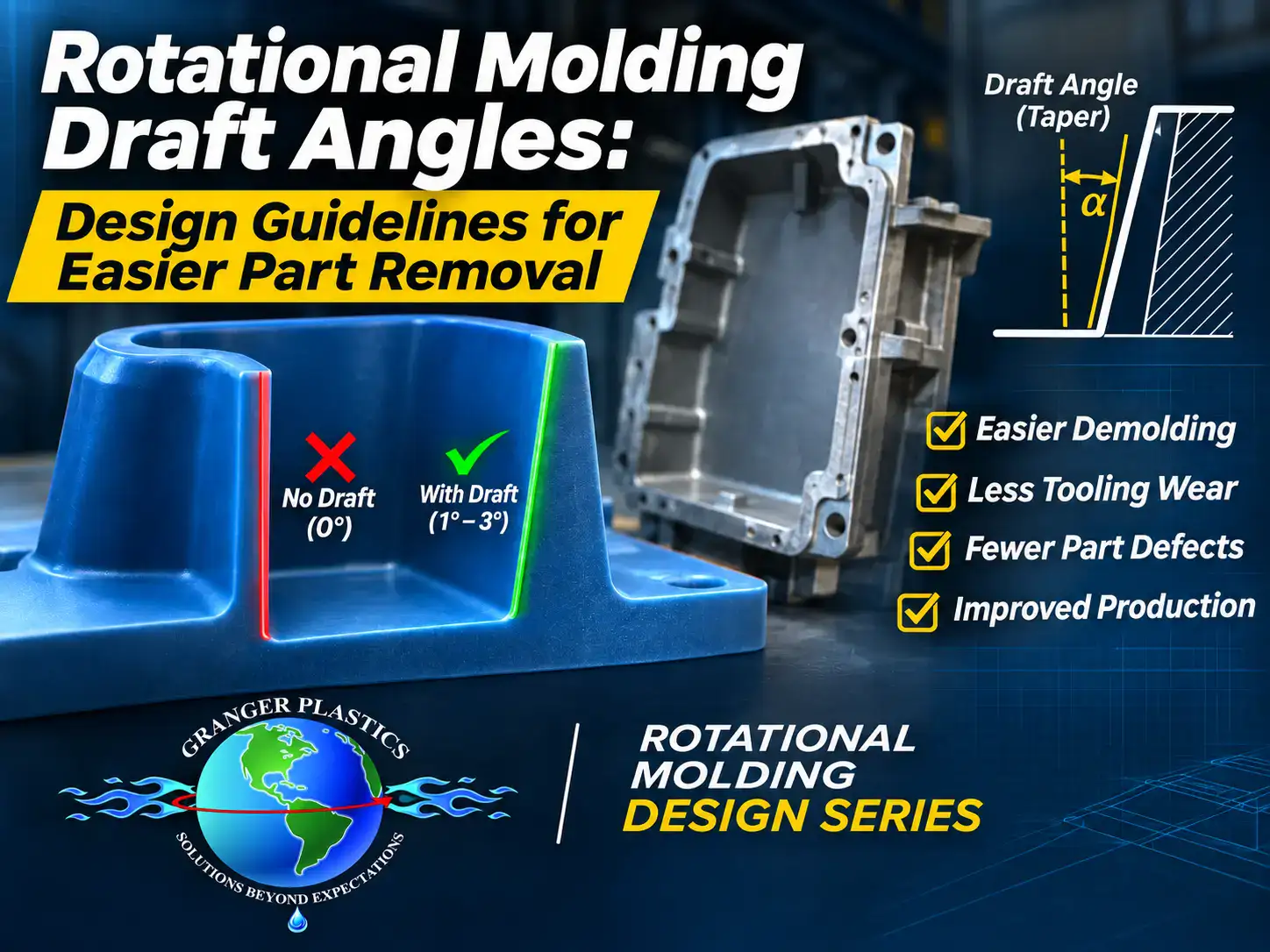
A location that provides excellent cosmetic results may create difficult demolding conditions, while a mechanically convenient mold split may place a visible seam across a critical exterior surface. Proper rotational molding draft angles can also help improve part release and reduce unnecessary resistance during demolding.
The objective is to develop a parting line configuration that balances manufacturability, appearance, functional performance, and production economics.
How Engineers Determine the Best Parting Line Location
Parting line selection begins with understanding the geometry of the proposed rotomolded product.
Engineers evaluate the direction in which the finished part will be removed, the position of protruding features, the depth of recessed areas, and any shapes that may mechanically interfere with mold separation.
Features such as molded handles, ribs, mounting bosses, recesses, and undercuts can complicate the separation of mold sections.
Where possible, parting lines may be positioned along natural changes in the product's geometry. Corners, edges, flanges, and transitions can sometimes provide locations where a molding seam is less visually prominent.
However, the location must still permit adequate tooling alignment, effective closure, and reliable removal of the finished part.
This is one reason early rotational molding design evaluation is so important. A small modification to a product's geometry can sometimes simplify mold construction and reduce secondary manufacturing operations.
Two-Piece vs. Multi-Piece Rotational Molds
Many rotationally molded products can be produced using molds consisting of two primary sections. This arrangement is generally straightforward to open, close, and maintain.
However, complex part geometry may require three or more mold sections, removable components, or specially designed tooling arrangements.
Two-Piece Rotational Molds
Two-piece molds can offer several practical advantages:
- Fewer mold interfaces to maintain
- Simpler opening and closing procedures
- Potentially reduced setup and handling labor
- Fewer locations where flash may develop
- Less complex alignment and fastening systems
These benefits depend on the part's geometry and the specific mold construction.
Multi-Piece Rotational Molds
Multi-piece molds may be necessary when product features prevent a finished component from being removed through a simpler mold opening.
Although additional mold sections can provide greater design flexibility, they also introduce more mating surfaces, alignment requirements, fastening points, and opportunities for wear.
Each additional mold section may increase tooling complexity and the time required to prepare the mold for production.
For a detailed look at construction methods, visit our molds for rotational molding resource.
What Causes Flash Along Rotational Molding Parting Lines?
Flash is unwanted excess plastic material that forms at or near the interface between adjoining mold sections.
In rotational molding, flash can develop when molten polymer reaches a gap or discontinuity at a mold's mating surfaces.
Although rotational molding is generally considered a low-pressure manufacturing process, the condition of the mold interface still matters. The mold experiences repeated heating, cooling, mechanical handling, and closure cycles that can influence the fit of its sections over time.
Potential contributors to parting line flash include:
- Worn or damaged mating surfaces
- Improper alignment of mold sections
- Insufficient or inconsistent mold closure
- Polymer residue or debris on mating surfaces
- Distortion caused by thermal or mechanical stresses
- Damaged fastening or alignment hardware
- Tooling repairs that have altered the original mold interface
Flash formation should not automatically be attributed to a single processing variable. Identifying the underlying cause requires evaluating mold condition, closure, part geometry, and operating practices.
How to Reduce Flash in Rotational Molding
Reducing unwanted flash usually begins with maintaining the precision and condition of the mold's mating surfaces.
1. Maintain Proper Mold Alignment
Rotational molds depend on reliable alignment so that adjoining sections return to their intended positions during every molding cycle.
Alignment pins, locating features, hinges, and other mold hardware should be inspected and maintained as appropriate for the tooling design.
2. Inspect Mating Surfaces
Damage, corrosion, polymer buildup, and debris can prevent mold sections from closing correctly.
Regular inspection and cleaning help identify conditions that could contribute to inconsistent closure or flash.
3. Evaluate Clamping and Fastening Systems
Fasteners and clamping arrangements must maintain appropriate closure throughout the heating and cooling cycle.
Loose, worn, improperly adjusted, or damaged hardware can contribute to parting line problems.
4. Consider Thermal Behavior
Mold materials, geometry, support structures, and temperature changes can influence how mold sections behave during production.
Problems that only appear after repeated heating cycles may require evaluation of tooling distortion or other thermal effects.
5. Repair Damaged Tooling
When flash results from worn or damaged mold interfaces, trimming the finished products does not correct the source of the problem.
Appropriate tooling repair may be necessary to restore consistent mold closure and production quality.
Our article on rotational mold repair and restoration examines a real-world tooling project involving repairs to damaged mold features, including parting lines.
Parting Line Flash vs. Normal Mold Witness Lines
It is important to distinguish between a normal parting line witness mark and excessive flash.
A witness line is a visible indication of the mold interface that may remain even when the mold operates correctly.
Flash, by contrast, involves excess material extending beyond the intended product geometry.
The presence of a minor witness line does not necessarily indicate defective tooling or an unacceptable product.
Acceptability depends on the requirements of the application, including cosmetic standards, dimensional tolerances, assembly conditions, safety considerations, and customer specifications.
For some industrial products, a modest parting line is functionally insignificant. For highly visible consumer components or precision interfaces, stricter finishing and appearance requirements may apply.
How Parting Lines Affect Rotomolded Product Appearance
Cosmetic requirements frequently influence where a rotational molding parting line should be located.
A seam across a broad, visible exterior panel may be less desirable than one located near an edge, recessed area, or natural transition.
Texture can also affect the appearance of molded surfaces. If a parting line crosses a textured region, the finished product may require more careful trimming to avoid noticeable differences in appearance.
Design teams should establish cosmetic expectations before tooling fabrication whenever possible.
For products with critical appearance requirements, decisions about the parting line, texture, mold finish, and allowable witness marks should be considered together.
Rotational Molding Parting Lines and Dimensional Accuracy
Parting line condition can also influence dimensional consistency.
If mold sections do not return to the same relative position during every cycle, certain exterior dimensions or molded features may vary.
Parting line mismatch can be especially important near mating surfaces, assembly features, or areas where the molded component interfaces with another manufactured part.
However, parting lines are only one factor affecting dimensional accuracy.
Polyethylene shrinkage, cooling behavior, part geometry, wall thickness, material selection, and processing conditions can also influence the dimensions of a finished rotomolded component.
For additional guidance, see our technical article on rotational molding tolerances and dimensional accuracy.
Trimming and Finishing Rotationally Molded Parting Lines
After a plastic product has been removed from its mold, secondary finishing operations may be necessary to meet customer requirements.
Depending on the design, these operations can include removing excess flash, smoothing parting line areas, drilling openings, trimming molded features, or performing additional assembly work.
The amount of finishing required varies with the mold design, process consistency, product geometry, and acceptable cosmetic standards.
Excessive trimming can increase labor requirements and create opportunities for inconsistent finished dimensions or surface appearance.
It is therefore beneficial to evaluate trimming requirements during product development instead of assuming they will be insignificant.
The objective is not necessarily to eliminate every visible trace of the parting line. Rather, it is to produce a finished component that consistently meets the application's functional and cosmetic requirements.
How Parting Line Complexity Influences Rotational Mold Cost
Parting line design can influence the initial investment required to manufacture a rotational mold.
A relatively simple mold split may be less complicated to manufacture and maintain than a design requiring multiple precisely fitted mold sections, complex contours, or specialized release features.
Tooling cost considerations may include:
- Number of mold sections
- Length and complexity of mating surfaces
- Machining and fitting requirements
- Alignment hardware and fastening systems
- Structural support and reinforcement
- Assembly and disassembly procedures
- Expected maintenance requirements
- Secondary trimming and finishing operations
These factors should be evaluated alongside product size, mold material, construction method, and anticipated production volume.
Our guide explaining how much a rotational mold costs explores the broader relationship between part design, tooling complexity, and manufacturing investment.
Why Parting Line Maintenance Matters for Long-Term Production
A rotational mold is a production asset that may be used through many heating, cooling, opening, and closing cycles.
Repeated handling, thermal cycling, and normal mechanical wear can gradually influence mold alignment and parting line condition.
Routine mold maintenance can help identify potential problems before they create significant production interruptions.
Depending on the tooling, maintenance may involve inspecting mating surfaces, checking closure hardware, removing material buildup, evaluating wear, and repairing damaged areas.
When tooling problems are detected early, corrective work may help avoid more extensive repair requirements.
For manufacturers using customer-owned rotational molds, maintaining the condition of these interfaces is particularly important because deterioration may affect product consistency and the long-term value of the tooling investment.
Designing Parting Lines for Tanks, Containers, and Industrial Components
Parting line requirements vary with the type of product being manufactured.
Custom Rotomolded Plastic Tanks
For tanks, parting lines should be evaluated in relation to the product's geometry, mounting features, fluid connections, and any surfaces that must accommodate seals or fittings.
Parting line location should not compromise critical interfaces, and the completed tank should be evaluated against applicable performance and containment requirements.
Material Handling Containers
Industrial containers may experience repeated impact, stacking, handling, and transport conditions.
Parting lines and molded features should be reviewed to ensure the finished product meets its intended structural and functional requirements.
Equipment Housings and OEM Components
Complex housings may include recessed surfaces, attachment features, openings, and detailed exterior geometry.
In these applications, choosing an effective mold split can reduce tooling complexity while supporting assembly accuracy and cosmetic quality.
These considerations illustrate why rotational molding design should be tailored to the actual product rather than relying on a universal parting line configuration.
Parting Line Design Checklist for Engineers and OEMs
Before finalizing a rotomolded product design, engineering and purchasing teams should consider the following questions:
- Where will the mold open, and how will the finished part be removed?
- Can the product be manufactured with two mold sections, or are additional sections required?
- Will the parting line cross critical sealing, mounting, or assembly surfaces?
- Are cosmetic expectations clearly defined?
- Can the mold sections be reliably aligned and secured?
- Are any recessed features, protrusions, or undercuts likely to complicate demolding?
- How much trimming or finishing may be required?
- Can the mating surfaces be inspected, cleaned, and repaired effectively?
- Could a small product-design change simplify the mold?
- Have tooling and finishing requirements been considered in the total manufacturing cost?
Addressing these questions during the early design phase may reduce tooling revisions and improve the repeatability of the manufacturing process.
Frequently Asked Questions About Rotational Molding Parting Lines
What is a parting line in rotational molding?
A parting line is the location where two or more sections of a rotational mold meet. It establishes where the mold separates to release the finished plastic product and may leave a visible witness line on the molded surface.
What causes flash on a rotationally molded part?
Flash can occur when molten plastic reaches gaps or discontinuities between mold sections. Worn mating surfaces, improper alignment, debris, damaged hardware, or tooling distortion may contribute to the problem.
Can rotational molding parting lines be eliminated?
Most conventional multi-piece rotational molds require a separation interface. Careful design, tooling precision, and appropriate finishing can minimize the visual impact of the resulting witness line, but eliminating all evidence of the mold interface is not always practical.
Do more mold sections increase manufacturing costs?
Additional mold sections can increase tooling complexity, alignment requirements, mold handling, and maintenance needs. The actual cost depends on the product geometry, mold construction, and production requirements.
Can a damaged rotational molding parting line be repaired?
In many cases, damaged mold mating surfaces can potentially be repaired or restored. Feasibility depends on the mold material, construction, extent of damage, and precision required to restore proper fit.
Do parting lines affect the strength of rotomolded plastic products?
The parting line itself does not automatically create a weak finished product. However, problems such as improper mold closure, excessive flash, local defects, or poorly designed features may affect the product's performance and should be evaluated.
Partner With The Granger Plastics Company for Custom Rotational Molding
Successful rotational molding begins with engineering decisions that support both the finished product and the manufacturing process required to produce it.
From parting line placement and mold construction to material selection, production, trimming, and assembly, every stage can influence product quality and manufacturing economics.
The Granger Plastics Company provides custom rotational molding capabilities, tooling fabrication, engineering support, mold maintenance, and manufacturing services for OEMs and industrial customers.
Whether developing a new product or evaluating existing tooling, working with an experienced rotational molding manufacturer can help identify potential production challenges before they become expensive problems.
Learn more about our rotational molding capabilities, or contact Granger Plastics to discuss your custom manufacturing requirements.