

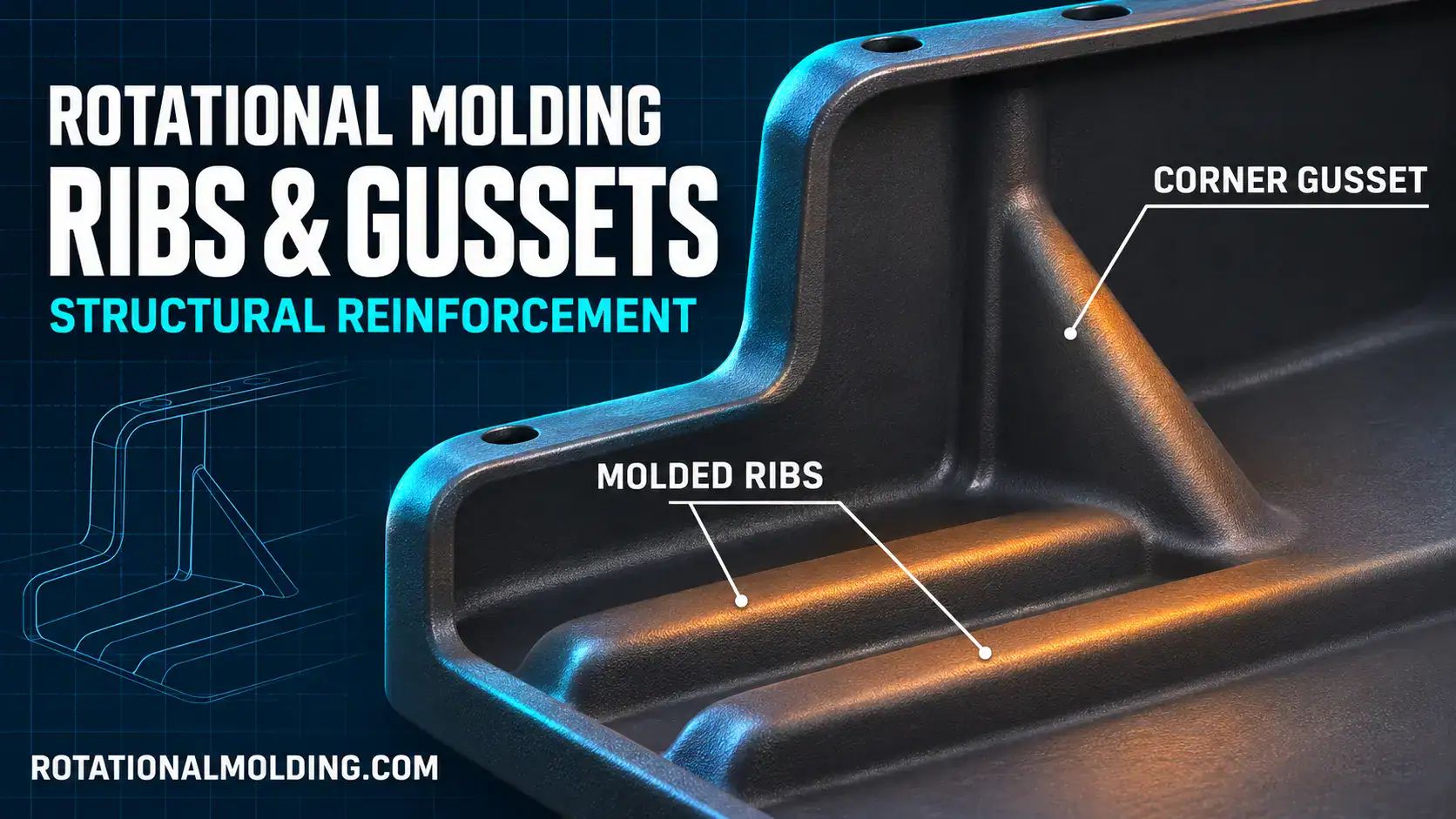
How Ribs, Gussets, Kiss-Offs and Molded Geometry Can Improve the Strength and Stiffness of Rotomolded Plastic Parts
Strengthening a rotationally molded plastic part does not always mean making the entire product thicker.
One of the major advantages of good rotational molding design is the ability to use geometry strategically. Ribs, gussets, contours, kiss-offs and other molded structural features can increase stiffness, control large surfaces and reinforce critical areas without simply adding more plastic throughout the entire part.
This can be particularly important for large hollow products where relatively broad wall sections must resist bending, deformation, impact or repeated handling.
At The Granger Plastics Company, structural reinforcement is evaluated together with wall thickness, material selection, product geometry, mold construction, draft, resin flow, cooling behavior and the intended use of the finished component.
The objective is not to add as many ribs as possible.
The objective is to design structural features that work effectively with the rotational molding process.
Why Rotationally Molded Parts Use Structural Ribs
Rotational molding is particularly well suited to producing large, hollow and seamless plastic products.
Because the process creates a hollow component rather than a solid molded structure, many products contain broad wall sections relative to their overall size.
A large panel may have adequate material thickness but still flex more than desired simply because of its unsupported span.
Increasing the nominal wall thickness can increase stiffness, but that is not always the most efficient solution.
Additional material can also increase:
- Part weight
- Resin consumption
- Heating requirements
- Cooling requirements
- Rotational molding cycle time
- Finished-part cost
Properly designed ribs can reduce unsupported spans and change the geometry of a surface so that it better resists bending.
That means structural performance can sometimes be improved significantly without proportionally increasing the amount of material in the entire product.
Rotational Molding Ribs vs. Simply Increasing Wall Thickness
Wall thickness remains an important engineering variable, but thicker is not automatically better.
As discussed in our guide to rotational molding wall thickness, increasing the resin charge generally increases nominal wall thickness, but it also increases material usage and may increase both heating and cooling time.
If the actual design problem is excessive flex across a broad panel, increasing the wall thickness of the entire product may add significant weight while only indirectly addressing the problem.
A rib, contour, crown or other structural feature can change the section geometry itself.
This is similar to the engineering principle behind corrugated panels, formed sheet metal and structural beams: shape can dramatically influence stiffness.
For rotationally molded products, the most efficient design often combines an appropriate nominal wall thickness with structural geometry rather than relying on either one alone.
What Is a Rib in Rotational Molding?
A rib is a molded geometric feature incorporated into the wall of a product to increase stiffness or provide reinforcement.
Depending on the product, ribs may be:
- Long and linear
- Short and localized
- Rounded or rectangular in profile
- Arranged in parallel
- Placed in a grid or intersecting pattern
- Integrated with corners or transitions
- Used around mounting or load-bearing areas
The dimensions and placement of the rib should be determined by the structural requirement as well as the ability of polyethylene or another molding resin to flow through and form the geometry consistently.
A rib that looks impressive in CAD is not necessarily an effective rotational molding rib.
The feature also has to mold.
Shallow Ribs Can Be Better Than One Deep Rib
Designers sometimes assume that the deepest possible rib will produce the strongest possible part.
That approach can create manufacturing problems.
Deep narrow ribs essentially create closely spaced mold walls. If those surfaces are too close together, the moving powder inside the mold may have difficulty entering the feature or may bridge across the opening.
This can contribute to:
- Thin wall sections
- Incomplete material coverage
- Voids
- Irregular wall distribution
- Poorly formed rib geometry
For this reason, several shallower ribs may sometimes be easier to mold and more practical than one extremely deep, narrow rib.
The number, spacing and orientation of ribs should therefore be evaluated as part of the entire molded geometry rather than simply maximizing rib depth.
Rotational Molding Rib Width and Depth
There is no single rib dimension appropriate for every rotationally molded part.
Nominal wall thickness, resin characteristics, mold material, feature depth, surrounding geometry and process conditions all influence what can be molded successfully.
However, useful design relationships can provide a starting point.
Industry design guidance for rotational molding has historically favored ribs that are relatively broad rather than extremely narrow. One useful starting relationship is a rib width of approximately five times the nominal wall thickness with a rib height of approximately four times the nominal wall thickness.
These are design guidelines rather than absolute manufacturing limits.
For example, on a product designed around a 0.250-inch nominal wall, a conceptual rib based on that relationship would begin around:
- 1.25 inches wide
- 1.00 inch high
Actual dimensions may be larger or smaller depending on the specific product.
The important principle is that deep, extremely narrow geometry can restrict material movement and heat transfer.
Broad, smoothly transitioned structural features generally give the rotational molding process more opportunity to form the wall consistently.
Parallel Walls and Material Bridging
Deep ribs create another important rotational molding consideration: parallel-wall spacing.
When two mold surfaces are located very close together, resin can bridge across the opening rather than moving freely through the feature.
A commonly used rotational molding design guideline is to provide approximately five times the nominal wall thickness between closely spaced parallel mold surfaces.
For a 6 mm nominal wall, this would correspond to approximately 30 mm of spacing.
This should not be interpreted as a universal minimum dimension.
Complex geometry can sometimes be developed successfully at different spacing, but increasingly narrow passages may require additional tooling and process development.
The relationship between wall thickness and geometry should therefore be evaluated before the mold is built.
Rounded Ribs Can Improve Manufacturability
Sharp geometric transitions are generally more difficult for rotational molding than smooth transitions.
Rounded ribs and generous radii allow material to move through the mold more naturally and reduce abrupt changes in geometry.
Rounded features can also reduce localized stress concentrations in the finished product.
This does not mean every reinforcing feature needs to have an identical rounded profile.
Rectangular or more defined ribs may provide greater structural stiffness in certain applications.
The design challenge is balancing the structural benefit of the rib against the ability to form the geometry reliably.
Draft Angles Matter on Reinforcing Ribs
A well-designed reinforcing rib still has to release from the mold.
Deep rib sidewalls that are effectively vertical may create unnecessary resistance during demolding.
Providing adequate taper can help the finished plastic part separate from the tooling as it is removed.
The necessary taper depends on factors including feature depth, mold texture, material shrinkage, geometry and the direction of part removal.
For a deeper discussion, see our guide to rotational molding draft angles.
Draft should therefore be considered when the rib is initially designed rather than added as an afterthought after tooling has already been fabricated.
What Are Gussets in Rotational Molding?
Gussets are structural transitions used to reinforce the relationship between adjoining surfaces or features.
They may be useful where a wall, boss, mounting area or structural feature intersects another section of the molded product.
Rather than allowing the feature to terminate abruptly, a gusset can blend the load into a broader portion of the surrounding wall.
This may help:
- Reduce localized flex
- Distribute mechanical loads
- Support mounting areas
- Strengthen corners and transitions
- Reduce abrupt stress concentrations
Rotational molding gussets should still follow the same general principles as other molded geometry.
Extremely narrow features, sharp corners and difficult-to-reach cavities may interfere with resin flow or create uneven wall distribution.
Broad, smoothly blended transitions are generally preferable.
What Is a Kiss-Off in Rotational Molding?
Kiss-offs are among the most useful structural features available to designers of rotationally molded products.
A kiss-off is created when two opposing wall sections are brought sufficiently close together that the molded surfaces connect or effectively tie the walls together.
This can dramatically change the structural behavior of a double-wall product.
Instead of two relatively independent plastic surfaces flexing separately, the kiss-off creates a connection between them.
Kiss-offs can be used to improve:
- Structural stiffness
- Dimensional stability
- Resistance to panel deflection
- Load transfer between opposing surfaces
- Control of large double-wall sections
They can also perform other functions in certain products, including internal baffling or creating molded passages and attachment features.
Linear Kiss-Off Ribs vs. Single-Point Kiss-Offs
Kiss-offs do not always have to extend across a large portion of a product.
Different configurations can serve different purposes.
Linear Kiss-Off Ribs
A linear kiss-off extends across a length of the part and effectively ties opposing surfaces together along that path.
This can provide substantial reinforcement to large double-wall panels.
Single-Point Kiss-Offs
A single-point kiss-off creates a localized connection between opposing walls.
Multiple point connections can sometimes be distributed across a broad area to control movement while preserving the overall double-wall construction.
Kiss-Through Features
Some designs extend the feature completely through the product to create a molded passage.
Depending on the application, these passages may provide locations for:
- Fasteners
- Axle or hinge pins
- Mounting hardware
- Drain features
- Structural connections
These features require careful tooling design and adequate heat transfer so that material forms properly around the geometry.
Kiss-Off Gap Is Critical
A kiss-off does not necessarily mean the two mold surfaces physically contact each other.
There is typically a controlled gap between opposing mold features so that molten resin can form a connection between the two molded walls.
If the gap is too large, the walls may not form an adequate connection.
If the gap is too small, the restricted opening can interfere with powder movement and prevent sufficient material from entering the area.
A commonly cited starting point is a kiss-off gap of approximately 175% of the nominal wall thickness.
For example, with a 0.250-inch nominal wall:
0.250 × 1.75 = approximately 0.438 inch
That dimension should be treated as a development starting point rather than an absolute production specification.
Actual kiss-off performance depends on mold geometry, material, heating, wall thickness and processing conditions.
Heat Transfer Can Become More Difficult in Deep Reinforcement Features
Every molded structural feature changes the geometry of the mold itself.
Deep projections, narrow features and areas surrounded by additional tooling mass may heat differently from broad open mold surfaces.
If adequate heat does not reach the end of a deep rib or kiss-off feature, less material may accumulate in that area.
Potential tooling and process strategies can include:
- Adjusting feature geometry
- Changing local mold thickness
- Improving airflow around the mold
- Using localized heating techniques where appropriate
- Modifying processing parameters
- Revising rib width or depth
This is another reason structural reinforcement should be considered together with rotational molding mold design rather than designed independently from the tooling.
Ribs Can Help Control Large Flat Surfaces
Large flat surfaces are inherently challenging in many molded plastic products.
During cooling, polyethylene contracts. Broad unsupported sections can bow, dish, oil-can or otherwise move away from an ideal flat condition.
Increasing wall thickness does not automatically solve this problem.
Strategically placed reinforcing ribs can reduce the unsupported span of the panel and increase its resistance to deformation.
Other potential approaches include:
- Adding gentle contours
- Crowning the surface
- Using double-wall construction
- Adding kiss-offs
- Breaking the surface into smaller structural sections
- Using post-mold cooling fixtures where justified
The appropriate solution depends on how flat the product actually needs to be and what loads it will experience in service.
Rib Placement Matters as Much as Rib Size
A large rib in the wrong location may contribute less than a smaller rib placed where the product actually flexes.
Designers should consider the expected load path through the finished component.
Important questions include:
- Where will the product carry weight?
- Where will it be supported?
- Where will users push, pull or stand on it?
- Where will hardware be attached?
- Which surfaces are most likely to flex?
- Where will impact loads occur?
- Are large unsupported spans present?
Structural geometry can then be concentrated where it provides useful reinforcement instead of adding unnecessary complexity to every surface.
Avoid Creating Unnecessary Tooling Complexity
Every additional rib, recess, gusset or structural feature becomes part of the mold.
That can influence tooling construction, part release, mold maintenance and manufacturing cost.
Complex reinforcement may require more complicated mold construction or additional mold sections if the geometry creates an undercut or interferes with the direction of demolding.
The location of reinforcement should therefore be evaluated together with the rotational molding parting line and the way the product will be removed from the mold.
A minor change in rib direction or feature location can sometimes produce similar structural performance while substantially simplifying the tooling.
Structural Reinforcement Should Be Designed Early
Ribs and kiss-offs are most effective when they are incorporated during the initial product-development process.
Trying to add structural geometry after tooling has already been manufactured may require welding, machining, casting modifications or substantial mold reconstruction.
Early collaboration between product designers, engineers and the rotational molder allows structural requirements to be evaluated before those decisions become expensive to change.
This is particularly important for products involving:
- Large unsupported panels
- Heavy loads
- Repeated impact
- Double-wall construction
- Mounting points
- Stacking requirements
- Fluid pressure or movement
- Outdoor structural applications
Rotational Molding Structural Design Is a System
No individual rib dimension or reinforcement rule can guarantee a successful rotationally molded product.
Structural performance depends on the relationship between:
- Nominal wall thickness
- Minimum wall requirements
- Material properties
- Rib geometry
- Kiss-off design
- Corner radii
- Draft angles
- Parting-line location
- Tooling construction
- Resin flow
- Heating and cooling
- Final service loads
A well-designed product balances all of these variables.
One of the strengths of rotational molding is the freedom it provides to create large hollow parts with integrated structural geometry. When that geometry is designed specifically for the process, ribs, gussets and kiss-offs can provide significant reinforcement while maintaining reasonable material usage and manufacturability.
Rotational Molding Rib and Reinforcement Design Checklist
Before finalizing a rotationally molded product, engineers and OEMs should consider:
- Does the product contain large unsupported flat surfaces?
- Can stiffness be improved through geometry rather than additional wall thickness?
- Are reinforcing ribs broad enough for resin to enter and form consistently?
- Are any ribs unnecessarily deep or narrow?
- Is adequate spacing provided between closely positioned mold surfaces?
- Are corners and rib transitions properly radiused?
- Is adequate draft provided for demolding?
- Could kiss-offs improve a double-wall structure?
- Will deep features receive sufficient heat?
- Are ribs placed along useful load paths?
- Could the reinforcement create an undercut or complicate the mold parting line?
- Can a simpler geometric feature accomplish the same structural objective?
- Have wall thickness, resin selection and geometry been evaluated together?
- Has the rotational molder reviewed the design before tooling fabrication?
Frequently Asked Questions About Rotational Molding Ribs
Can ribs make a rotationally molded plastic part stronger?
Yes. Properly designed ribs can increase stiffness, reduce panel flex and improve structural performance by changing the geometry of the molded wall. Their effectiveness depends on their location, size, orientation and the surrounding product geometry.
Is adding a thicker wall better than adding ribs?
Not necessarily. Increasing wall thickness may improve performance, but it also increases resin usage, weight and potentially cycle time. Structural ribs or contours can sometimes provide greater stiffness more efficiently.
How deep should a rotational molding rib be?
There is no universal rib depth. Rib dimensions should be evaluated relative to nominal wall thickness, material flow, surrounding geometry and structural requirements. Multiple shallower ribs may sometimes mold more reliably than one deep narrow rib.
Do rotational molding ribs need draft?
Deep rib sidewalls generally benefit from appropriate draft so the finished part can release from the mold more easily. The required draft depends on feature depth, material shrinkage, mold texture and removal direction.
What is a kiss-off in rotational molding?
A kiss-off is a molded feature that connects or ties opposing walls of a double-wall rotationally molded product. Kiss-offs can substantially increase stiffness and dimensional stability and can also provide baffling or molded-through attachment features.
Can ribs help prevent warpage in rotationally molded parts?
Ribs can help control large unsupported panels and increase resistance to deformation, although warpage can also be influenced by wall thickness, material shrinkage, cooling conditions, mold geometry and processing parameters.
Designing Stronger Rotationally Molded Products
Successful structural design in rotational molding is not simply a matter of adding more plastic.
It is about using wall thickness, material and geometry together.
Properly designed ribs, gussets, kiss-offs, contours and double-wall features can improve stiffness and structural performance while helping control material usage and manufacturing cost.
The earlier these features are evaluated, the greater the opportunity to optimize both the molded product and the tooling required to manufacture it.
The Granger Plastics Company works with OEMs, engineers and product developers to evaluate custom rotational molding designs, tooling requirements, material selection and structural geometry before production begins.
To learn more about developing products specifically for the process, visit our Rotational Molding Design resource or explore our complete guide to Rotational Molding.