

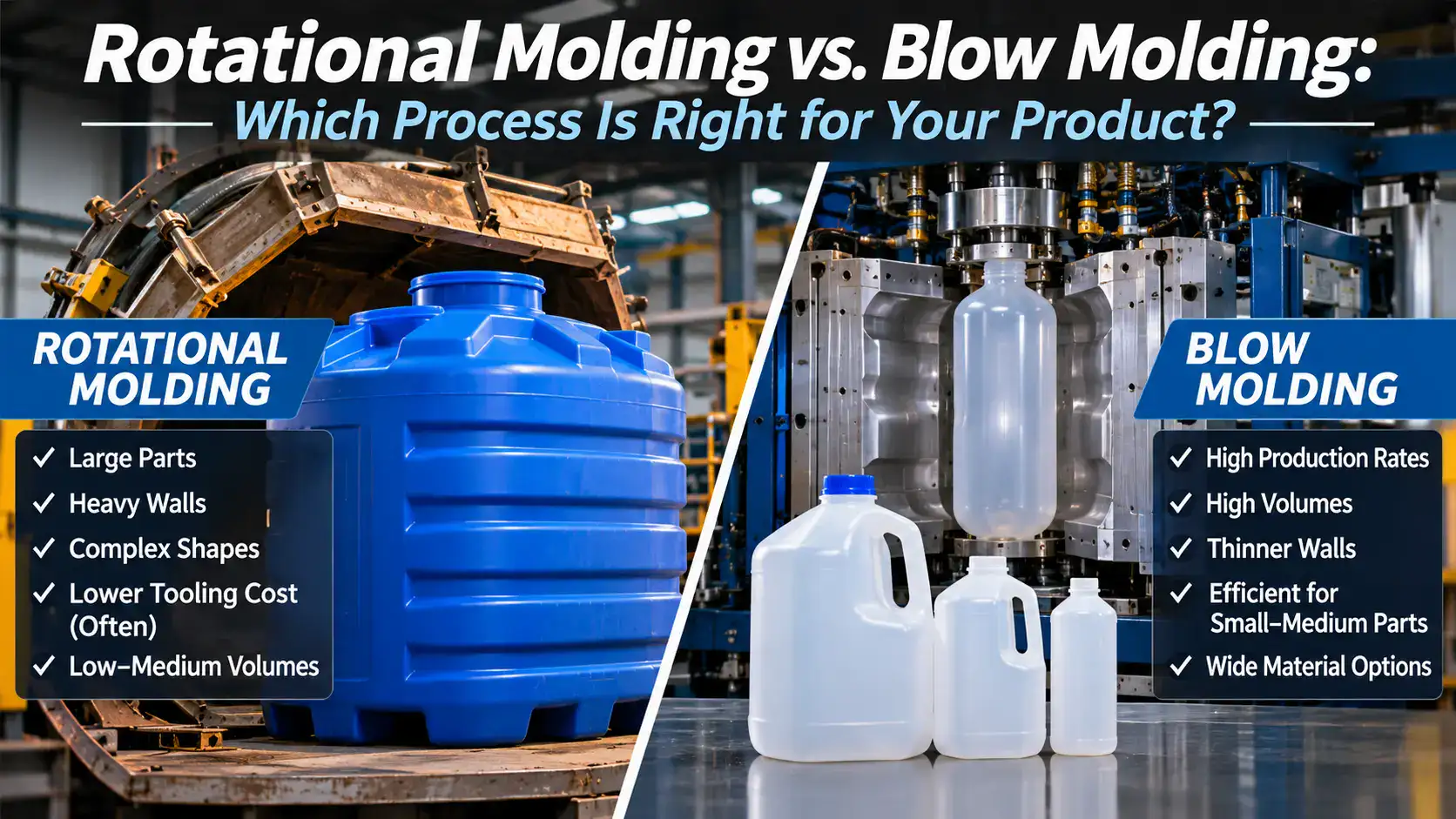
Rotational Molding vs. Blow Molding: Which Process Is Right for Your Product?
Key Differences in Tooling, Production Volume, Part Size, Wall Thickness, Materials and Design Flexibility
By RotationalMolding.com Editorial Team
Published November 2, 2026
Understanding rotational molding vs blow molding can be challenging because both manufacturing processes are commonly used to produce hollow plastic products.
The two processes form plastic differently, require different types of tooling and manufacturing equipment, and are often best suited to very different combinations of part size, wall thickness, production volume, geometry and product performance.
Rotational molding, also known as rotomolding, uses heat and biaxial rotation to gradually distribute polymer inside a hollow mold. Blow molding typically uses air pressure to expand heated plastic against the walls of a mold.
Neither manufacturing process is universally better.
The correct choice depends on what the finished product must do, how large it is, how many parts must be manufactured, the required wall construction and the economics of the overall production program.
Rotational Molding vs. Blow Molding at a Glance
| Consideration | Rotational Molding | Blow Molding |
|---|---|---|
| Primary Application | Large, durable hollow products | High-volume hollow products |
| Forming Method | Heat and biaxial rotation | Air pressure expands heated plastic |
| Tooling Investment | Often comparatively lower | Frequently higher for larger industrial products |
| Production Speed | Longer molding cycles | Typically faster cycles |
| Production Volume | Often low-to-medium volume | Often medium-to-very-high volume |
| Part Size | Excellent for large and extremely large hollow parts | Commonly small-to-medium hollow parts; large parts possible with appropriate equipment |
| Wall Construction | Heavy walls and multi-wall designs possible | Commonly optimized for thinner hollow walls |
| Wall-Thickness Control | Influenced by resin charge, geometry and heat transfer | Influenced by parison design, programming and part geometry |
| Molded-In Features | Inserts, threads and attachment features can often be incorporated | Design possibilities depend heavily on equipment and process |
| Product Durability | Excellent for rugged industrial products | Excellent when properly designed for the application |
| Typical Examples | Tanks, containers, material-handling products, marine products and industrial components | Bottles, containers, ducts, reservoirs and high-volume hollow products |
What Is the Fundamental Difference Between Rotational Molding and Blow Molding?
The biggest difference is how the plastic reaches the mold surface.
During the rotational molding process, a measured quantity of polymer—most commonly powdered polyethylene—is placed inside a hollow mold.
The mold is heated while rotating simultaneously around two axes. As the mold becomes hot, the polymer gradually melts and adheres to the interior surface. Continued rotation distributes the material throughout the mold until the part is formed.
There is no injection system or air pressure forcing the material against the mold wall.
Blow molding approaches the problem differently.
In a common form known as extrusion blow molding, heated plastic is extruded as a hollow tube called a parison. A mold closes around the parison, and compressed air expands the plastic outward until it contacts the interior surface of the mold.
The molded product is then cooled and removed.
Other variations of blow molding include injection blow molding and stretch blow molding, but when manufacturers compare rotomolding with blow molding for larger industrial hollow products, extrusion blow molding is frequently the most relevant comparison.
That difference—rotating material inside the mold versus inflating material against the mold—creates many of the differences in tooling, part design, wall thickness and production economics.
Tooling Cost: Rotational Molding vs. Blow Molding
Tooling investment is often one of the first major differences considered when comparing the processes.
Rotational molding is a relatively low-pressure manufacturing process. Because the mold does not have to resist the same forming forces associated with many pressure-driven plastics processes, rotational molds can often be constructed economically from fabricated aluminum, fabricated steel or cast aluminum.
The appropriate mold construction depends on product geometry, production requirements, surface finish and anticipated mold life.
This can make rotational molding particularly attractive when a company needs:
- A large hollow plastic product
- Low-to-medium production quantities
- Multiple product sizes
- A product that may require future design modifications
- Tooling investment that must remain practical relative to annual volume
For additional information about rotational tooling, see How Much Does a Rotational Mold Cost?
Blow molding tooling can be highly productive, but the complete manufacturing system must also support extrusion or preform production, mold clamping, air pressure, cooling and rapid repetitive cycling.
For very high production quantities, that additional investment can make excellent economic sense because it can be spread across enormous numbers of finished products.
This illustrates an important principle:
The least expensive mold does not necessarily produce the least expensive product, and the most expensive mold does not necessarily produce the most expensive product.
Tooling and production volume must be evaluated together.
Production Volume and Cycle Time
Blow molding generally has a significant advantage when production speed is the dominant requirement.
Once an appropriate blow molding process, tooling system and manufacturing cell are established, hollow plastic products can often be produced at very high rates.
This is one reason blow molding is widely used for bottles, consumer containers and other products manufactured in extremely large quantities.
Rotational molding operates differently.
The mold must be loaded, heated while rotating, cooled while rotation continues and then opened so the finished product can be removed.
These longer thermal cycles generally make rotational molding less suitable for extremely high-volume commodity products that need to be produced every few seconds.
That does not mean rotational molding is restricted to tiny production quantities.
Rotomolding is used for substantial commercial production programs throughout industrial, agricultural, marine, material-handling and other markets. Multiple molds, mold arms and machines can also increase manufacturing capacity.
The question is whether the production volume justifies the equipment and tooling required by the competing process.
Part Size
Part size is one of rotational molding's most important advantages.
Rotomolding can manufacture products ranging from relatively small components to extremely large hollow structures.
Because the process does not require a massive injection unit or depend on rapidly inflating a parison across a large geometry, rotational molding can be especially practical for products such as:
- Large industrial tanks
- Bulk storage containers
- Material-handling products
- Marine products
- Agricultural components
- Large housings and enclosures
- Waste and laundry containers
- Custom industrial products
Blow molding can certainly produce large products, and large industrial blow molding machines exist.
However, as product size increases, the equipment required to extrude, control and inflate a sufficiently large parison can become a major consideration.
This is why product size cannot be separated from tooling investment and projected production quantity when comparing the two processes.
Wall Thickness
Wall thickness is another area where the manufacturing methods differ substantially.
In rotational molding, the quantity of resin placed into the mold is one of the primary factors determining nominal wall thickness.
But resin charge alone does not guarantee identical thickness throughout every area of the product.
Part geometry, mold construction, heat transfer, rotational ratios and processing conditions all influence material distribution.
Our guide to rotational molding wall thickness examines these factors in greater detail.
Rotational molding is particularly valuable when an application requires substantial wall thickness, impact resistance or localized structural durability.
Some specialized rotomolded products can be manufactured with very heavy walls that would be impractical for many other hollow-plastic manufacturing methods.
Blow molding usually begins with a parison whose thickness can be controlled or programmed before and during formation.
As the parison expands, however, different areas stretch by different amounts. Product geometry and parison programming therefore influence the final material distribution.
Modern blow molding equipment can provide sophisticated control, but the engineering problem remains different from rotational molding.
Neither process automatically produces perfectly uniform walls.
The important question is whether the wall distribution achievable through the selected process meets the product's structural and dimensional requirements.
Product Geometry and Design Flexibility
Rotational molding provides substantial flexibility for large hollow products and complex geometry.
The process can often incorporate:
- Molded-in inserts
- Threaded attachments
- Double-wall construction
- Ribs and structural features
- Complex contours
- Handles
- Recesses
- Logos and molded identification
- Multiple integrated functions that might otherwise require assembly
Good rotational molding design must still account for material flow, heat transfer, draft, radii, wall spacing and mold construction.
Rotomolding is flexible—but it is not magic. Geometry that creates poor heating or prevents resin from reaching an area of the mold can still cause manufacturing problems.
Blow molding can also manufacture sophisticated hollow geometries, but the design must accommodate the way the parison is captured and inflated.
Deep or highly irregular sections can stretch the material significantly. Pinch-off areas and parison accessibility also influence product design.
This is why a product originally designed for blow molding should not necessarily be copied directly into a rotational mold—or vice versa.
The product should be designed around the process that will manufacture it.
Seamless Construction and Part Consolidation
One of the most valuable characteristics of rotational molding is its ability to manufacture a large hollow product as a single molded structure.
This can allow designers to replace assemblies that might otherwise require:
- Multiple molded components
- Welding
- Fasteners
- Gaskets
- Fabricated sections
- Secondary joining operations
Reducing part count can simplify assembly and eliminate potential failure points.
Blow molding also produces one-piece hollow components, but extrusion blow-molded products typically include pinch-off regions where the parison is captured and sealed during molding.
Whether that characteristic matters depends entirely on the application.
For many blow-molded products it is completely appropriate.
For a heavy-duty industrial product where large seamless construction, thick sections or complex integrated features are priorities, rotational molding may provide a more natural manufacturing solution.
Materials
Polyethylene dominates rotational molding because it provides a valuable combination of processing behavior, impact resistance, chemical resistance, durability and cost.
LLDPE, MDPE and HDPE grades may all be considered depending on the application.
Selecting a material requires more than simply choosing a resin family. Density, melt index, impact properties, stiffness, environmental exposure, chemical requirements and processing characteristics can all influence performance.
See our guide to rotational molding polyethylene and resin selection for a deeper discussion.
Blow molding also uses polyethylene extensively, along with polypropylene, PET and numerous other thermoplastics depending on the specific blow molding process and application.
If the product requires a particular polymer, the ability of each process to use that material successfully should be evaluated before tooling decisions are made.
Durability and Product Performance
Manufacturing process alone does not determine whether a product is durable.
Material selection, geometry, wall thickness, loading, UV exposure, chemical environment and actual service conditions all matter.
Rotational molding is particularly well suited to products expected to tolerate:
- Repeated handling
- Outdoor exposure
- Impact
- Large loads
- Harsh industrial environments
- Marine environments
- Agricultural use
- Material-handling abuse
Heavy-wall construction, rounded geometry and one-piece design can create extremely rugged products.
Blow-molded products can also provide excellent durability when properly engineered.
The correct question is not simply:
Which process makes the stronger product?
It is:
Which process can manufacture the product geometry, material and wall construction required for the actual service environment most efficiently?
When Rotational Molding Is Usually the Better Fit
Rotational molding deserves serious consideration when a product requires several of the following:
- Large hollow construction
- Heavy or durable walls
- Seamless one-piece geometry
- Complex shapes
- Relatively low tooling investment
- Low-to-medium production volumes
- Molded-in inserts or attachment features
- Double-wall construction
- Large products that might otherwise require fabrication
- Flexibility for future product or tooling modifications
For a broader discussion of the strengths and limitations of the process, see our guide to the advantages and disadvantages of rotational molding.
When Blow Molding May Be the Better Fit
Blow molding may deserve stronger consideration when a product requires:
- Very high production quantities
- Rapid repetitive manufacturing
- Relatively thin hollow walls
- Small or medium hollow containers
- Geometry well suited to parison inflation
- Production economics that justify specialized tooling and equipment
Common bottles, jugs and other high-volume packaging applications demonstrate why blow molding can be exceptionally efficient.
Attempting to rotationally mold a commodity bottle by the millions would generally make little manufacturing sense.
Likewise, attempting to force a very large, heavy-wall industrial product into blow molding simply because the process has faster cycles may create unnecessary equipment and tooling challenges.
Rotational Molding vs. Blow Molding: Which One Is Better?
Neither.
The better process is the one that best matches the product.
Rotational molding and blow molding overlap because both can manufacture hollow plastic components, but they are optimized around different manufacturing requirements.
A large industrial container manufactured in moderate quantities presents a completely different economic problem than a small container manufactured several million times per year.
The manufacturing decision should therefore consider the complete program:
- Product size
- Annual volume
- Required material
- Wall thickness
- Geometry
- Structural requirements
- Tooling investment
- Expected product life
- Secondary operations
- Future design changes
Focusing on only one of those variables can lead to an expensive manufacturing decision.
What About Injection Molding?
Rotational molding, blow molding and injection molding each occupy different areas of plastics manufacturing.
Injection molding is especially powerful for producing precise solid or open components at very high production rates, while blow molding is highly effective for many high-volume hollow products.
Rotational molding often becomes particularly attractive for large, hollow, durable products where comparatively economical tooling and design flexibility are important.
For a direct comparison with another major plastics manufacturing process, read Rotational Molding vs. Injection Molding: Which Process Is Right for Your Product?
Frequently Asked Questions
Is rotational molding cheaper than blow molding?
It depends on product size, tooling, production volume and manufacturing requirements. Rotational molding can offer comparatively economical tooling, particularly for large products and low-to-medium production quantities. Blow molding's faster production rates can provide substantial economic advantages when very high production volumes justify the tooling and equipment.
Is blow molding faster than rotational molding?
Generally, yes. Blow molding commonly operates with significantly shorter production cycles. Rotational molding requires heating and cooling of the mold during each cycle, which generally results in longer cycle times.
Can rotational molding make large products?
Yes. Large and extremely large hollow plastic products are among the applications where rotational molding can be especially effective.
Which process produces thicker walls?
Rotational molding is particularly well suited to substantial wall thicknesses and heavy-duty hollow products. Blow molding is often optimized around thinner wall construction, although capabilities vary widely by equipment, material and product design.
Can both processes use polyethylene?
Yes. Polyethylene is widely used in both rotational molding and blow molding, although the specific resin grades and processing requirements differ.
Which process has less expensive tooling?
Rotational molding frequently provides lower initial tooling investment, particularly for large products and moderate production quantities. However, tooling cost should always be evaluated together with expected production volume and finished-part economics.
Can a blow-molded product be converted to rotational molding?
Potentially. The evaluation should consider product size, geometry, material, annual volume, wall thickness, tooling requirements and performance expectations. A product should normally be redesigned for the rotational molding process rather than simply duplicating the existing blow-molded geometry.
Choose the Manufacturing Process Before Building the Mold
The best time to compare rotational molding and blow molding is before significant tooling investment has been made.
If a product is large, hollow, durable, structurally demanding or manufactured in quantities that do not justify highly specialized high-volume tooling, rotational molding may provide an attractive solution.
The Granger Plastics Company has more than three decades of experience evaluating products for rotational molding, developing tooling and manufacturing custom rotomolded products across a wide range of industries.
If you are developing a new plastic product, converting an existing manufactured assembly or evaluating whether another plastics process could be replaced with rotational molding, our team can help review the product geometry, material, tooling and production requirements.
Explore our complete rotational molding capabilities, learn more about rotational molding design, or request a rotational molding quote to discuss your application.