

How Undercut Geometry, Polyethylene Shrinkage, Draft, Parting Lines and Mold Design Affect Demolding of Rotomolded Parts
Rotational molding provides designers with considerable freedom to create large, hollow and complex plastic products.
That design freedom can include features that would be difficult or expensive to manufacture using many other plastic molding processes.
One of those features is the undercut.
Undercuts can sometimes be successfully incorporated into rotationally molded products because materials such as polyethylene can shrink and remain relatively flexible during part removal. However, the fact that an undercut can potentially be molded does not mean every undercut can be removed easily from a simple two-piece mold.
Successful rotational molding undercuts depend on the relationship between product geometry, material flexibility, shrinkage, draft, mold construction, parting-line location and the direction in which the finished part must move during demolding.
At The Granger Plastics Company, undercuts are evaluated as part of the complete rotational molding design rather than as an isolated CAD feature.
The objective is simple:
Create the required product geometry while still allowing the finished part to be molded, released and manufactured consistently.
What Is an Undercut in Rotational Molding?
An undercut is a feature that prevents a molded part from being removed from the mold in a simple straight-line direction without either:
- Flexing or deforming the molded plastic
- Changing the mold parting line
- Using a removable mold section
- Using multiple mold sections
- Otherwise changing the tooling or demolding method
In rotational molding, an undercut may be an inward or outward projection, recess, shoulder, groove or other geometric feature that mechanically interferes with the normal path of mold removal.
The key issue is not simply whether the geometry exists.
The key question is:
Can the finished plastic part move past that feature without damage to the part or the tooling?
Why Rotational Molding Can Accommodate Some Undercuts
Polyethylene provides an important advantage when dealing with certain undercuts.
As a rotationally molded polyethylene part cools, the plastic shrinks.
The molded part may also remain somewhat flexible when it reaches the demolding stage.
That combination of shrinkage and flexibility may allow some relatively shallow undercuts to release even though the geometry would appear mechanically locked when viewed as a rigid CAD model.
This is one of the design freedoms that can make the rotational molding process attractive for complex hollow products.
However, this flexibility should not be treated as unlimited.
An undercut that requires excessive deformation can:
- Damage the finished part
- Distort the molded geometry
- Create excessive operator effort
- Increase demolding time
- Damage tooling surfaces
- Reduce production consistency
- Create stress in the molded plastic
The geometry must therefore be evaluated realistically before tooling is manufactured.
Not All Rotational Molding Undercuts Behave the Same
The term “undercut” describes many different geometric situations.
A shallow recess on a flexible wall may release relatively easily.
A deep recess surrounded by rigid structural walls may be extremely difficult or impossible to remove from a conventional two-piece mold.
Important variables include:
- Undercut depth
- Undercut length
- Wall flexibility
- Nominal wall thickness
- Polyethylene grade
- Material shrinkage
- Part temperature during demolding
- Nearby ribs or structural walls
- Corner geometry
- Mold texture
- Draft
- Parting-line location
For that reason, there is no universal maximum undercut depth that applies to every rotationally molded product.
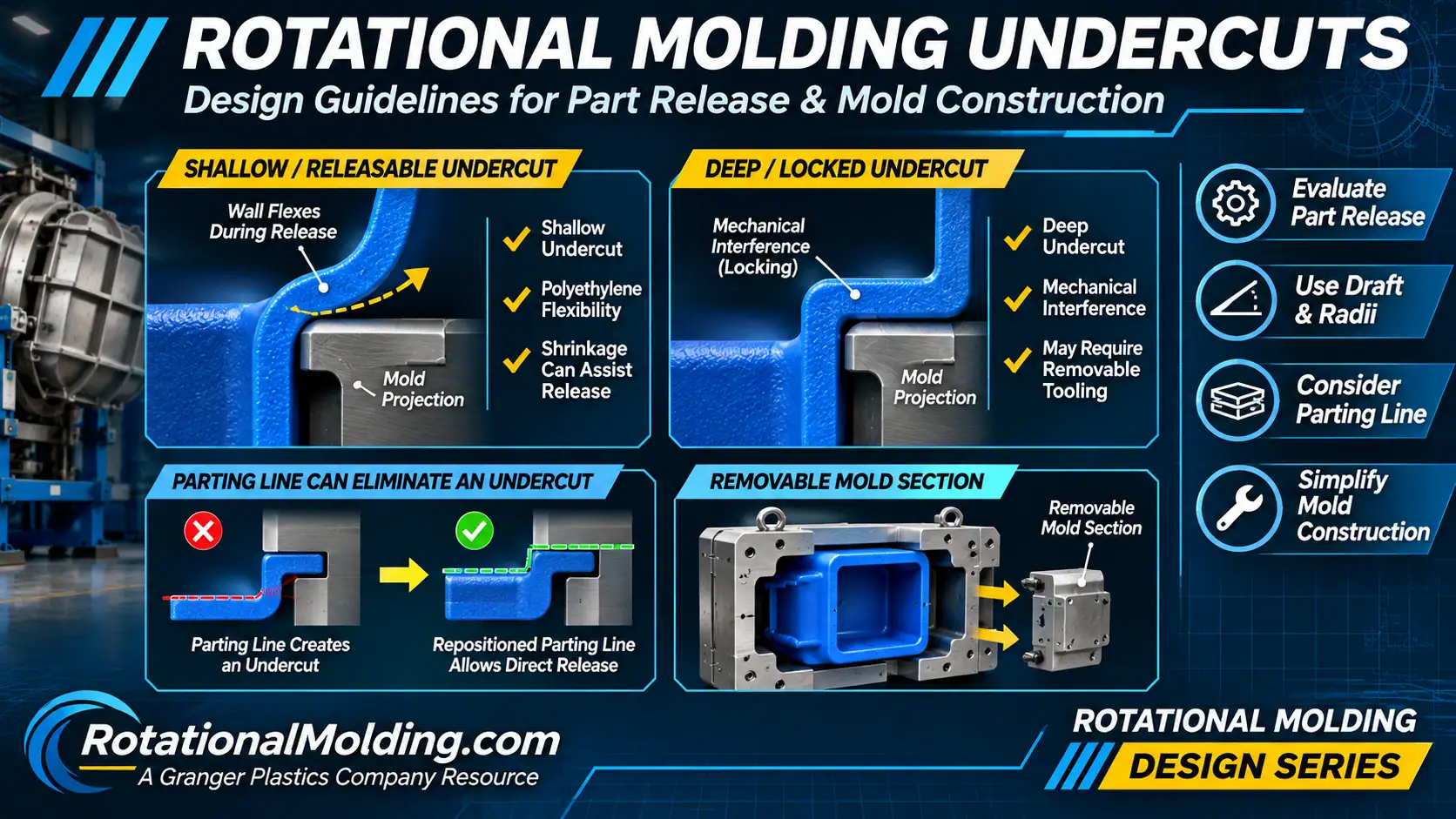
Shallow Undercuts May Release Through Part Flexibility
A relatively shallow undercut located in a flexible wall can sometimes be released by allowing the molded plastic to deform temporarily during demolding.
Once the feature clears the mold, the polyethylene may return toward its original molded shape.
This approach is most practical when the surrounding geometry allows the wall to move.
For example, a broad unsupported wall may be able to flex inward enough to clear a shallow projection.
The same undercut could become substantially more difficult if that wall is reinforced by:
- Ribs
- Gussets
- Kiss-offs
- Closely adjoining walls
- Thick structural sections
In other words, features intended to increase structural stiffness can also reduce the flexibility required to release an undercut.
This is why undercuts and rotational molding ribs and structural reinforcement should be evaluated together.
Deep Undercuts Can Create Mold-Locking Conditions
As the depth of an undercut increases, the amount of deformation required to remove the part also increases.
Eventually, the part may no longer be able to flex sufficiently without distortion or damage.
A deep undercut can effectively lock the finished product into the mold.
When this occurs, the solution may require:
- Relocating the mold parting line
- Changing the product geometry
- Reducing the undercut depth
- Adding removable tooling
- Creating a loose mold piece
- Using a multi-piece mold
These alternatives should be considered during product development rather than after the mold has already been fabricated.
Parting-Line Location Can Eliminate an Undercut
One of the most effective ways to address an undercut is sometimes to change where the mold separates.
A feature that is an undercut relative to one mold-opening direction may no longer be an undercut if the parting line is repositioned.
This can allow the mold sections to pull away from the feature instead of forcing the plastic part to deform around it.
However, changing the parting line can affect:
- Mold construction
- Flange location
- Flash
- Trimming requirements
- Cosmetic appearance
- Mold maintenance
- Part removal
Parting-line location should therefore be evaluated as part of the entire tooling strategy.
For more information, see our detailed guide to rotational molding parting lines.
Draft Angles and Undercuts Are Different
Draft and undercuts are closely related, but they are not the same design issue.
Draft is taper intentionally incorporated into a wall or feature to make removal from the mold easier.
An undercut creates actual geometric interference with the removal direction.
A wall with inadequate draft may create unnecessary friction or resistance during demolding.
An undercut may physically prevent removal until the plastic deforms or the mold geometry changes.
Adding draft can sometimes make an undercut easier to release by creating a smoother transition and reducing mechanical resistance.
However, draft cannot eliminate every true undercut.
See our complete guide to rotational molding draft angles for additional guidance on part release.
Smooth Radii Can Help Undercuts Release
The shape of the undercut can be just as important as its depth.
A sharp abrupt feature may create a stronger mechanical lock than a smoothly blended feature of similar overall size.
Generous radii can allow the molded wall to flex progressively rather than forcing it across a sharp edge.
Proper radii can also reduce stress concentrations during demolding.
This is another example of why rotational molding corner radii influence more than appearance.
They can directly affect manufacturability and part release.
Polyethylene Shrinkage Can Assist Demolding
Polyethylene shrinks as it cools.
Depending on the geometry, that shrinkage can either help or complicate part release.
When a molded feature shrinks away from a mold surface, release may become easier.
When the plastic shrinks tightly around a projection, insert or other mold feature, release may become more difficult.
The direction in which the material contracts relative to the mold geometry is therefore important.
Factors affecting dimensional behavior include:
- Polyethylene grade
- Density
- Nominal wall thickness
- Cooling rate
- Part geometry
- Mold construction
- Part temperature during removal
Our guide to rotational molding tolerances discusses shrinkage and dimensional behavior in greater detail.
Part Temperature Can Influence Undercut Release
A rotationally molded part is generally removed from the mold after it has cooled sufficiently to maintain its shape.
However, polyethylene is usually more flexible at elevated temperatures than after reaching ambient temperature.
That can sometimes assist in removing parts containing modest undercuts.
The process must still be controlled carefully.
Removing a part too hot can contribute to:
- Distortion
- Warpage
- Dimensional variation
- Surface damage
- Permanent deformation
The demolding strategy therefore has to balance flexibility with adequate dimensional stability.
Wall Thickness Influences Flexibility
Wall thickness can significantly affect whether an undercut will release.
A relatively thin polyethylene wall may flex more easily than a much heavier section.
However, simply reducing wall thickness to make an undercut easier to remove is rarely an appropriate engineering solution.
The wall still needs to meet the structural and performance requirements of the finished product.
The correct approach is to evaluate wall thickness, material properties and undercut geometry together.
For additional information, see our guide to rotational molding wall thickness.
Structural Reinforcement Can Make an Undercut Harder to Release
A molded wall may appear flexible enough to release from an undercut until ribs, gussets or other structural features are added.
Those features intentionally increase stiffness.
Unfortunately, they may also prevent the wall from deforming sufficiently during demolding.
Designers should therefore avoid evaluating an undercut using only the local feature.
The surrounding product structure matters.
An undercut located beside a rib, perpendicular wall or double-wall feature may behave very differently from the same feature in an open flexible panel.
Removable Mold Sections Can Solve Complex Undercuts
When the required product geometry cannot be released from a conventional two-piece mold, removable mold sections may provide a solution.
A removable section creates part of the mold cavity during molding but can be detached or moved before the finished product is completely removed.
This can allow much more complex geometry to be manufactured.
Potential applications include:
- Deep recesses
- Complex handles
- Protected openings
- Localized reverse geometry
- Mechanical attachment features
- Deep external projections
The tradeoff is increased tooling complexity.
Removable sections may increase:
- Mold fabrication cost
- Operator involvement
- Demolding time
- Mold maintenance
- Potential flash locations
- Cycle-to-cycle handling
The additional complexity must therefore be justified by the product requirement.
Multi-Piece Rotational Molding Molds
Simple rotational molds frequently consist of two major sections.
More complex parts may require three or more sections to accommodate geometry that cannot be released through a conventional two-piece split.
Additional mold sections can allow complex features to be produced while minimizing extreme deformation of the plastic part during removal.
However, every additional mold section can introduce:
- Another flange
- Another potential flash line
- Additional clamps or hardware
- More mold handling
- Additional maintenance
- Greater tooling cost
Good rotational molding design balances product complexity against manufacturing simplicity.
Our guide to rotational molding molds provides additional information about tooling construction.
Mold Release Can Affect Difficult Undercuts
Mold-release systems can reduce friction between the plastic and the tooling surface.
In some undercut situations, an appropriate release system may make demolding easier.
However, mold release should not be treated as a substitute for fundamentally workable product geometry.
A deeply locked feature does not become good rotational molding design simply because additional release agent is applied.
Geometry should first be designed so the part can realistically be removed.
Surface Texture Can Increase Demolding Resistance
Surface texture can increase mechanical interaction between the molded plastic and the mold.
A smooth undercut may release more easily than an identical feature with a heavy texture.
Texture depth, feature direction and draft should therefore be considered together.
This becomes especially important where the surface itself must deform to clear the undercut.
The same issue is discussed in our rotational molding draft-angle guide, because textured surfaces frequently require additional consideration during part release.
Undercuts Around Molded-In Inserts Require Special Attention
Rotationally molded products can incorporate threaded inserts, sleeves, bushings and other molded-in hardware.
The plastic typically shrinks tightly around these components as the part cools.
This can provide excellent mechanical retention when the insert is designed correctly.
However, a molded-in insert located near an undercut can also reduce local flexibility and change how the part releases.
Insert placement should therefore be evaluated together with:
- Undercut geometry
- Wall thickness
- Part shrinkage
- Ribs and gussets
- Tooling accessibility
- Demolding direction
These interactions should be reviewed before mold construction begins.
Undercuts Can Increase Production Labor
An undercut does not have to make a part impossible to mold to become expensive.
If operators must significantly flex, twist or manipulate every finished part to remove it from the tooling, the feature may increase cycle time and labor.
Over a long production run, a few additional minutes of demolding effort can become significant.
Complex release procedures may also increase variability between operators.
Designing for straightforward demolding can therefore improve:
- Production efficiency
- Cycle consistency
- Tooling life
- Part quality
- Operator ergonomics
Undercuts Should Be Evaluated Before Tooling Is Built
The easiest time to solve an undercut problem is during product design.
A CAD feature can often be changed in minutes.
Correcting the same problem after a cast aluminum or fabricated metal mold has been completed may involve:
- Machining
- Welding
- New mold sections
- Flange modifications
- Reworking adjacent geometry
- Substantial tooling expense
Early review with an experienced rotational molder can identify whether an undercut:
- Can release through normal polyethylene flexibility
- Needs additional draft or radius
- Should be reduced
- Should be relocated
- Can be eliminated through parting-line changes
- Requires removable tooling
Rotational Molding Undercut Design Checklist
Before releasing a rotational molding design for tooling, engineers and OEMs should consider:
- Does the geometry actually create an undercut relative to the mold-opening direction?
- How deep is the undercut?
- Can the surrounding polyethylene wall flex enough to clear the feature?
- Will nearby ribs or walls prevent that flexing?
- Does material shrinkage help or hinder removal?
- Can additional draft improve release?
- Can larger radii reduce mechanical locking?
- Would moving the parting line eliminate the undercut?
- Will surface texture increase removal resistance?
- Could the undercut distort the part during demolding?
- Does the geometry require a removable mold section?
- Would a multi-piece mold provide a better solution?
- How much labor will the demolding procedure require?
- Has the rotational molder reviewed the geometry before tooling fabrication?
Frequently Asked Questions About Rotational Molding Undercuts
Can rotationally molded parts have undercuts?
Yes. Some undercuts can be successfully molded because polyethylene shrinks and remains relatively flexible during demolding. Whether a specific undercut will release depends on its depth, geometry, surrounding structure, material and mold design.
Why can polyethylene parts release from some undercuts?
Polyethylene can shrink during cooling and can remain flexible enough during demolding to deform temporarily around certain mold features. This flexibility can allow relatively shallow or properly designed undercuts to release.
Can draft eliminate an undercut?
Draft can make some features easier to release, but a true undercut creates geometric interference with the removal direction. Significant undercuts may require changes to the geometry, parting line or tooling.
Can changing the mold parting line solve an undercut?
Yes. A feature that is an undercut relative to one mold-opening direction may become directly releasable when the mold is divided differently. Parting-line changes should also be evaluated for tooling cost, flash and appearance.
Do undercuts increase rotational mold cost?
They can. Undercuts that require removable sections, additional mold pieces or more complicated tooling can increase mold fabrication cost and production labor.
How deep can a rotational molding undercut be?
There is no universal maximum depth. Feasibility depends on material flexibility, wall thickness, shrinkage, surrounding geometry, undercut shape, mold construction and the amount of deformation the finished part can tolerate during removal.
Designing Complex Rotationally Molded Parts
Undercuts demonstrate one of the most important principles of successful rotational molding design:
The finished product and the mold must be designed together.
A feature that looks simple in CAD may become difficult to manufacture if the removal path is not considered.
Conversely, a feature that initially appears difficult may be practical when polyethylene shrinkage, material flexibility, draft, radii and mold construction are used intelligently.
The Granger Plastics Company works with OEMs, engineers and product developers to evaluate rotational molding geometry, tooling requirements, materials and manufacturability before production begins.
Early design collaboration can reduce tooling changes, improve part release and help create products that take advantage of the unique design freedom offered by rotational molding.
For additional engineering guidance, visit our Rotational Molding Design resource or our complete guide to Rotational Molding.